
Northrop Grumman partners with AI startup to revolutionize rocket design
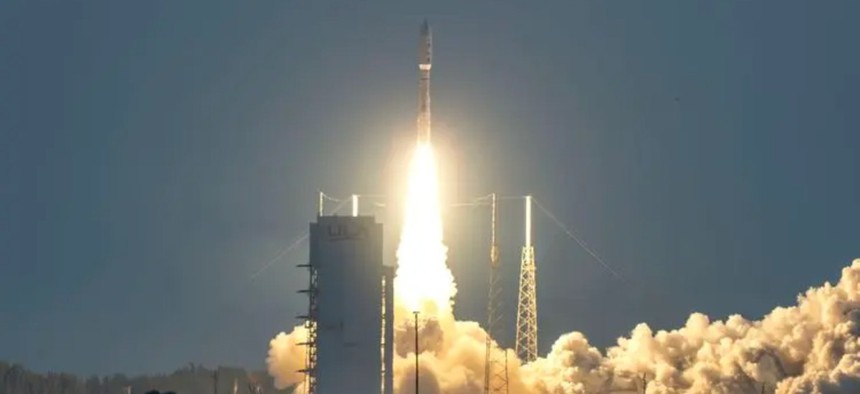
An Atlas V rocket with five Northrop Grumman engines launches from Cape Canaveral, Florida, last year. Northrop Grumman

 By
Nick Wakeman
By
Nick Wakeman
Physics AI from Luminary Cloud is designed to bring down analysis time from hours to just seconds.
Northrop Grumman plans to use the power of artificial intelligence to design its rockets more quickly and efficiently by signing an agreement with a startup that offers what it calls physics AI.
The agreement between Northrop and Luminary Cloud was announced Tuesday at NVDIA's developer conference known as GTC. Luminary, which secured $72 million in funding last month, offers AI that runs on NVIDIA’s NeMo framework.
Juan Alonso, chief technology officer and co-founder of Luminary, told Washington Technology generative AI models are not good at certain things like high-level math and physics even after being trained on massive amounts of data. Alonso is also the head of the aeronautics and astronautics department at Stanford University.
The data sets of a physics AI models are trained on includes how physical systems behave. They work to process complex engineering problems such as aerodynamics, structural analysis, electromagnetics and heat transfer.
“Physics AI models are going to change the way engineering is done and in particular, how defense engineering is done,” Alonso said.
The agreement with Northrop will start by looking at thruster-nozzles for rockets.
Stay in the know — Washington Technology’s Insider Membership gives you unmatched access to breaking news, in-depth analysis, and insights that federal contractors can’t afford to miss. Join today for 50% off.
Historically, aerospace designs have relied on CPU-based computation fluid dynamics simulations that can take hours complete and analysis. For the physics AI model Northrop will be using, Luminary ran about 3,000 simulations to create a model that can analyze nozzle designs in seconds.
“You can see very quickly that if it takes you hours to do an analysis, you’re going to do 30 or 40 analyses, but if it takes you than a second, you can do hundreds,” Alonso told WT.
Physics AI also brings better information earlier in the process, which helps avoid costly mistakes later.
“What we’re trying to do is bring high-fidelity information early in the design stage with these different disciplines represented so you get actionable information when it matters – when you’re conceiving the design,” he said.
The work on the rocket thruster is just the beginning.
“Using AI to make something small, like a spacecraft thruster, puts us on a path to do much bigger things, like using AI to design larger components or even an entire spacecraft,” Han Park, vice president of AI integration at Northrop, told WT.
Northrop and Luminary started working together in part because Park and Alonso knew each other from Park’s pervious position at Supernal, Hyundai’s electric vertical takeoff company.
But Northrop is also leaning forward.
“They know that its critical to their competitive posture to be able to develop these systems more quickly,” Alonso said.
The work started by defining the problem statement and developing a range of operating conditions, altitudes, chamber pressures and geometries of the different thrusters.
“We took all of those inputs and developed a large data set of simulations to train our physics AI models,” Alonso said.
Luminary is also working on models involving unmanned systems, drones and automobiles.
“We are at an inflection point because these technologies are mature enough that they can transition to production,” Alonso said.