
Walkinshaw wants congressional oversight to include FITARA reboot
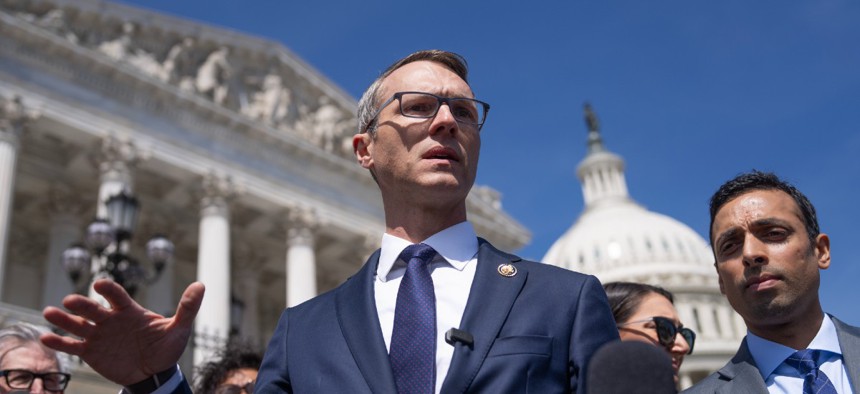
Rep. James Walkinshaw (D-Virginia) speaking outside the Capitol in April. Gettyimages.com/Tom Williams

 By
Nick Wakeman
The Democratic lawmaker representing parts of Northern Virginia says the incoming majority should bring back IT oversight scorecards as part of a post-DOGE rebuild of government.
Most expect the Democratic-controlled Congress to focus on oversight when the new session begins in January, but that does not mean a sole focus on claims of corruption and malfeasance by the Trump administration.
For Rep. James Walkinshaw (D-Virginia), Congress should also return to its traditional oversight activities that include hearings and scorecards sparked by the Federal IT Acquisition Reform Act from 2014. That kind of accountability has fallen by the wayside in recent years.
“I’ve been advocating for a modernized modernization scorecard,” Walkinshaw said Thursday at GovExec's After the Midterms event. “When we developed the FITARA scorecards, we weren’t talking about AI adoption in the federal government, and I don’t think we ever quite got to where we wanted to capture cybersecurity metrics and judging agencies against a cybersecurity metric.”
Walkinshaw wants to return to the practice driven by his predecessor and former boss, Gerry Connolly, and Republican counterpart Darrell Issa.
Connolly and Issa together developed FITARA and annual scorecards to get it passed as part of the National Defense Authorization Act for Fiscal Year 2015.
“Congress didn't just pass the bill and say mission accomplished. Congress said we passed the bill and now every year we're going to follow up and make sure agencies are implementing it,” Walkinshaw said. “I think that bore real fruit. It saved taxpayers billions of dollars. It helped us retire legacy systems that I think otherwise wouldn't have been retired. It’s a really powerful model.”
Walkinshaw, one of Congress’ chief critics of the Department of Government Efficiency, sees the cuts as an opening for a reboot of a post-DOGE government.
He said this is “a moment where we can, I hope, build that but do it in a better, smarter way. And I think Congress has to lead in that.”
On customer service, Walkinshaw said his constituents run into trouble when digital services do not fully solve their problem and cannot get a human on the phone.
Agencies like the Social Security Administration and Office of Personnel Management have largely gone digital for customer service because of workforce reductions.
“That makes people really, really angry,” he said.
The new Congress will be sworn in on Jan. 3. Before that, the lame duck session will need to deal with passing some sort of budget bill.
“Lame duck sessions are hard to predict because people who just lost their election or are retiring may not choose to show up for work,” Walkinshaw said.
Current House Speaker Mike Johnson (R-Louisiana) has to figure out what can get passed.
“Republicans are going to have a real attendance challenge and that can create some volatility,” Walkinshaw said. “But I think a shutdown is unlikely.”
Walkinshaw is hoping for bipartisan negotiations around individual appropriation bills, where both sides are open to negotiation. He predicted there will be some combination of passed spending bills and a continuing resolution for what is left that keeps the government open into January or February.
As the Democrats take the majorities in January, Walkinshaw said we should expect to see legislation focused on cost-of-living issues. He cited attempts to restore Affordable Care Act tax credits, roll back some of the Medicaid cuts and trying to wind back some of the tariffs.
“If we are successful in each of those things, it would have an impact on the bank accounts and pocketbooks of working families within weeks,” he said.
Democrats may have the House and Senate, but President Trump still has the White House and is a Republican.
“Our job in Congress is to pass legislation and get it onto his desk. At that point, he’ll have three choices,” Walkinshaw said.
Trump can sign or veto legislation. Choice number three is to negotiate, which Walkinshaw said he is open to if means having a conversation and meeting in the middle.
“I’ll just say as a Democrat having lived through this administration thus far, that hasn't been the posture, but if it changes, that'd be great,” he said.