
Accenture, Leidos execs on how to survive a divided government
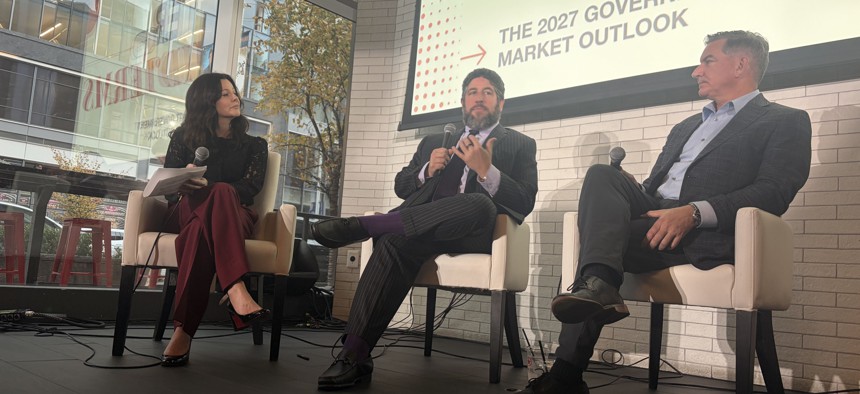
Accenture's Ira Entis (center) and Rich Wilson of Leidos discuss what government contractors face in today's market alongside moderator Christie Bardo, chief growth officer for GovExec. GovExec/Molly Field

 By
Nick Wakeman
Panelists say contractors need to plan for multiple scenarios as the Democrats prepare to take control of Congress with Trump still in the White House. Companies should also sell outcomes, not labor.
Federal contractors face a new set of unknowns on budgets and policy with Democrats taking control of Congress and President Donald Trump still in the White House.
But two veterans of the market are offering direct advice on how to weather this transition and the next two years of a divided government.
Speaking at GovExec’s After the Midterms event on Nov. 6, Accenture Federal Services' chief strategy officer Ira Entis said companies need to prepare three plans for today’s market.
Entis described the traditional plan as one of “lumpy funding” with a continuing resolution. The challenging plan is one “where there is going to be disruptions, funding pullbacks and customer cancellations,” he said.
Then there is the rosy plan that assumes lots of money will flow toareas such as artificial intelligence, cyber and Defense Department priorities.
“If you think of this not as one scenario but three, and then you look at things that are critical in every one of the scenarios, then we have no brainer things that we have to invest in,” Entis said.
Companies should invest in those areas no matter which scenario plays out, Entis added.
Rich Wilson, senior vice president of health and services growth at Leidos, said that focus is critical in today’s market.
“You cannot be a peanut butter spread across all the opportunities,” Wilson said.
Even a company the size of Leidos (No. 1 on the Washington Technology Top 100) does not have the resources to do everything, he said. Internally, companies need to be selective and make the bid-or-no bid decision quickly
At Leidos, Wilson said he focuses on improving the company’s agility around its growth operations.
“A lot of companies have built up very robust processes on top of processes,” Wilson said. “I would encourage everyone to really think about your growth teams.”
For example, Wilson said companies should ask if they are spending time working on solutions directly with clients or are putting together PowerPoint charts with the help of artificial intelligence.
“Are they doing really meaningful work out in the environment in the community you belong to?” Wilson said.
Both executives stressed that the market is shifting away from labor-based and cost-plus contracts to more outcome-based procurements, which they described as a historic shift.
Cost-plus contracts are a particularly bad way to buy technology because there is no incentive for the contractor to bring innovation and improvements, Entis said.
But the shift to outcomes opens the conversation to discussions around shared risk and innovation that can drive more creative approaches to solving the customer’s problem, the panelist said.
Accenture had one customer with a call center, where it cost $13 every time a person (a contractor) answered the phone.
By using agentic AI, Accenture Federal built a system that could handle more calls without a live person answering the phone. The contract was structured so that Accenture Federal did not get paid if a live person had to answer the call.
“If you go to a person, we get zero dollars, so we’re handling more than 50% of the requests and customer satisfaction is up,” Entis said.
Wilson said he is encouraged by agencies that are moving away from labor-heavy, multi-year contracts to more milestone-driven acquisitions.
“You can build a really aggressive contract and acquisition strategy to support moving faster and getting to those milestones, he said.
Wilson was a government buyer for the Army before he retired as a colonel. He sees updates to the Federal Acquisition Regulation, the increased use of other transaction authorities, and growth of pilot programs as positives for the customer and the GovCon industry.
“I remember being in government and I ran about a billion dollars a year and no one ever offered to put an OTA in place to accelerate some sort of pilot,” Wilson said. “Those things are fantastic.”
Entis and Wilson also cautioned against too much focus on new technology.
“In this time of unprecedented technological change, it’s critical to constantly challenge assumptions and have that balance though of not just thinking about implementing tech for tech’s sake,” Entis said.
Wilson said people inside and outside of government are good at describing the problem, but not so good at describing everything that goes into the solution.
“They can’t get to all those things you need to do to achieve the mission outcomes,” Wilson said. “We are a technology forward company but that’s not the whole solution.”
Wilson said more consideration needs to be given to policy changes, doctrines, change management and workflows instead of just throwing more technology at the problem.
The same goes for proposals, Wilson said. Agencies are seeing more bids than ever because companies are leaning on AI to write them and many are getting rejected, which Wilson characterized as “rightly so."
“While it’s an accelerator, you just can’t outsource creativity, you can’t outsource judgment,” Wilson said.