Opponents of open source software applauded a recent OMB memo that they claim puts proprietary software on competitive footing with open source software in federal procurements.
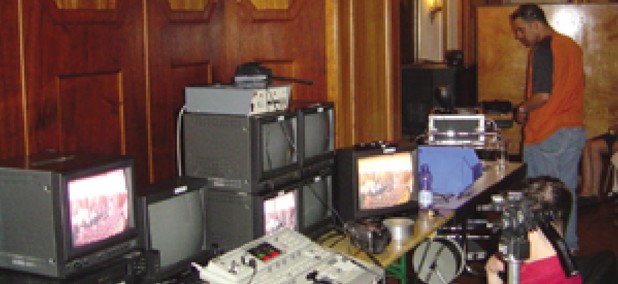
Clad in tasseled caps and purple gowns, 50 seniors at Wurzburg High School in Germany stopped and posed briefly at the podium after receiving their diplomas. But instead of gazing at a teary-eyed audience, these students smiled into a donated video camera that relayed the event roughly 2,100 miles to their parents in Iraq.
Information technology services firm PlanetGov Inc. has changed its name to Apptis Inc. to reflect its recent acquisitions of IT companies and expanded services.
Information technology services firm PlanetGov Inc. has changed its name to Apptis Inc. to reflect its recent acquisitions of IT companies and expanded services.
When Richard Stanton filed an application for his company's first General Services Administration schedule last month, he did it electronically and became one of the first to use GSA's new eOffer program, which lets contractors apply online for IT Schedule 70.
The National Science Foundation can fund only a small number of the research proposals it receives on IT security, according to NSF official Peter Freeman.
Agencies using share-in-savings contracts for information technology work will be required to develop business cases for the contracts and make contract awards based on best value, according to a procurement rule proposed by the Federal Acquisition Councils. Agencies also must make all share-in-savings contracts performance-based.
Industry executives said they like what they hear so far about a rule under development at the White House that will tell agencies when they can use time-and-materials contracts.
The federal government July 2 published a proposed rule to authorize governmentwide use of share-in-savings contracts for federal IT projects. A final rule likely will take effect in the last quarter of 2004.
The Army Communications-Electronics Command at Fort Monmouth, N.J., needs contractors to provide functionally equivalent Joint Tactical Terminal Senior configurations, originally manufactured by Raytheon Network Centric Systems.
	The Homeland Security Department has issued a request for information for imaging systems for large-scale, nonintrusive inspection equipment at U.S. border crossings and seaports. The systems will be used to detect weapons of mass destruction, explosives, conventional weapons, drugs and other contraband concealed in steel-walled tankers, tractor trailers and other vehicles.
The Drug Enforcement Administration needs a contractor to provide equipment and related services for installing two long-range, off-the-shelf, multisensor camera systems on its aircraft. The cameras must allow targets to be viewed in all kinds of lighting conditions and provide housing in a gyro-stabilized turret that is easily mountable to a helicopter or airplane.
What can a small defense contractor learn from the leaders of commercial companies such as Huffy Corp., a maker of bikes and sports equipment, and Copeland Corp., a refrigeration and air-conditioning<BR>
ManTech International Corp., Fairfax, Va., released version 5.0 of its NetWitness wiretap tool. The new version includes better analytical features and increased abilities to monitor voice over IP traffic.
Even as the Defense Department builds a massive information grid often referred to as "network-centric warfare," experts say a new generation of software and sensors is needed to fulfill its promise. In a special report, Washington Technology found integrators and defense leaders struggling over how to make tactical use of the emerging network.
After three consecutive quarters of improvement in business performance, commercial IT spending dropped in June. Dozens of commercial software and hardware companies preannounced weak second-quarter results, blaming customer purchase delays and a lack of large sales.
The Small Business Administration still plans to simplify its small-business size standards despite its recent decision to reassess changes it proposed in March, according to <b>Gary Jackson</b>, assistant administrator for size standards. Thousands of public comments raised significant concerns about the planned changes and led SBA to pull back.