
Serial entrepreneur Ken Bajaj comes out of retirement to chase AI opportunity set
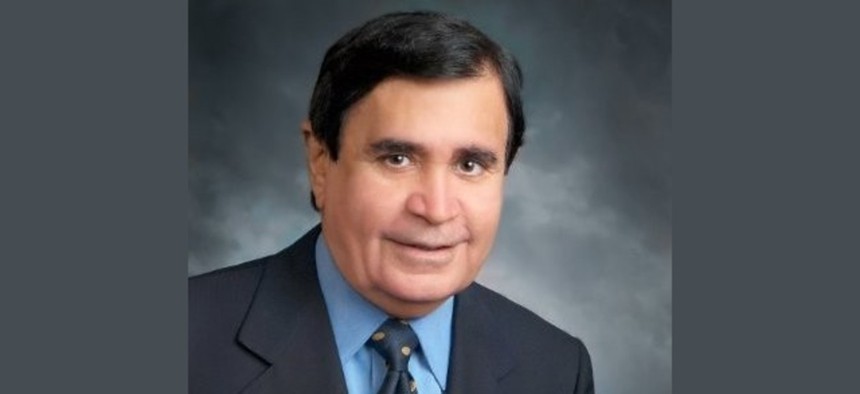
Ken Bajaj said he launched DigitalNet.ai because he couldn't resist the opportunity AI represents. DigitalNet.ai

 By
Nick Wakeman
By
Nick Wakeman
DigitalNet.ai forms out of a combination of three other companies to deliver a persona-based digital workforce to government agencies.
Ken Bajaj earned his semi-retirement after four decades of building and selling companies.
But the ongoing artificial intelligence wave was just too much of a lure for the serial entrepreneur to stay away from.
“This challenge is just too big to miss,” he told Washington Technology on the eve of the launch his new venture DigitalNet.ai.
DigitalNet.ai is focused on enterprise AI and was created through a merger of three existing businesses – Harmonic AI, Zillion Technologies and Axis Group. Bajaj is working with the private equity group Ulysses Management to build out the new company. The founders of the three acquired companies are retaining equity stakes in DigitalNet.ai.
The name of the new company harkens back to one of Bajaj’s previous ventures, DigitalNet. Bajaj also built and either sold or took public three other companies -- iNet, AppNet and DMI.
Bajaj built each of his companies to target what he calls paradigm shifts in the market. iNet focused on computer networking. Wang Laboratories bought that company for $167 million in 1996.
After selling iNet, Bajaj founded AppNet as an e-commerce company just as the dot-com boom took off in the late 1990s. AppNet went public in 1998 and was later sold to CommerceOne for $2.2 billion in June 2000.
He then launched DigitalNet as a managed services play and took it public in 2003. BAE Systems then acquired DigitalNet the next year for $600 million.
In 2009, Bajaj became chief operating officer of Digital Management Inc. His son Jay "Sunny" Bajaj founded DMI in 2002 and they built that business into a $400 million-annual revenue company focused on cloud computing and digital transformation. In 2021, they sold their majority stake in DMI to OceanSound Partners.
DigitalNet.ai is focusing on enterprise AI and the power of agentic AI.
“We are focused on AI solutions for large enterprises and government agencies,” Ken Bajaj said.
Right now, the company has about 1,500 employees and 82% of its $170 million in annual revenue is in the commercial sector. The remaining 18% of sales are with government agencies such as the Homeland Security Department, Health and Human Services Department, Federal Aviation Administration and Treasury.
“I’ll have a big focus on government so we can get to 50-50 and then take the business public,” Bajaj said.
To pursue AI opportunities, Bajaj said DigitalNet.ai needs three core capabilities. Harmonics AI brings the agentic AI platform, while the digital transformation and cybersecurity expertise comes from Zillion Technology.
Axis Group brings the data analytics and business intelligence services.
“To implement an enterprise AI solution, you need expertise in those areas,” he said. “Once a customer decides on an AI solution, then you need the data collection, the data management, the (large language model) platform to train and integrate with the back office.”
Agentic AI at scale brings the potential of savings and efficiency.
“You can automate 85% of the application lifecycle and the same with application modernization,” he said.
Fraud detection, and especially in the government sector, is another area of focus for DigitalNet.ai. The company built fraud detection tools into its platform, Bajaj said.
Bajaj sees DigitalNet.ai as going head-to-head with the likes of Palantir and C3 AI, but with the differentiator of using agentic AI.
“Our AI agents are persona-based agents. That means they think like human beings, they work like human beings,” he said. “Essentially we are offering digital human beings that supplement and complement the human workforce.”
DigitalNet.ai's platform accommodates over 80 LLMs and is cloud agnostic. That means it can run on Microsoft Azure, Amazon Web Services and Google Cloud.
The platform has built in integration for 60 tools including natural language processing, vision algorithms, speech algorithms, and decision-support algorithms.
DigitalNet.ai has taken steps to mitigate AI hallucinations in the platform.
“We can define the constitution and guardrails that the AI agents will work within to avoid hallucinations,” Bajaj said. “Then the agents can work autonomously or with a human in the loop.”
Bajaj believes every enterprise can use these kinds of AI tools to increase revenue, improve margins and bolster customer service. The government should augment its workforce with a digital workforce, he said.
“If you said, give me a persona for a systems analyst, we can create that or a project manager,” Bajaj said. “Our platform has a super project manager we call Zeus. Zeus manages the activities of the other AI agents to make sure they execute within the guardrails and within the constitution.”
Bajaj spent two years looking for the right pieces and "at hundreds of companies" to launch DigitalNet.ai.
More acquisitions are part of the growth plan, but they will be strategic and not focused primarily on scale. DigitalNet.ai also will work as a prime, directly with government customers, but it will also form partnerships with other primes.
Strategic partnerships are in the works.
“We are talking with people every day. A few are sitting in our conference room right now and we’re pitching our platform to them,” he said.
For Bajaj, it's clear that full retirement will have to wait.