
AeroVironment's tech and business blueprints with BlueHalo now in the fold
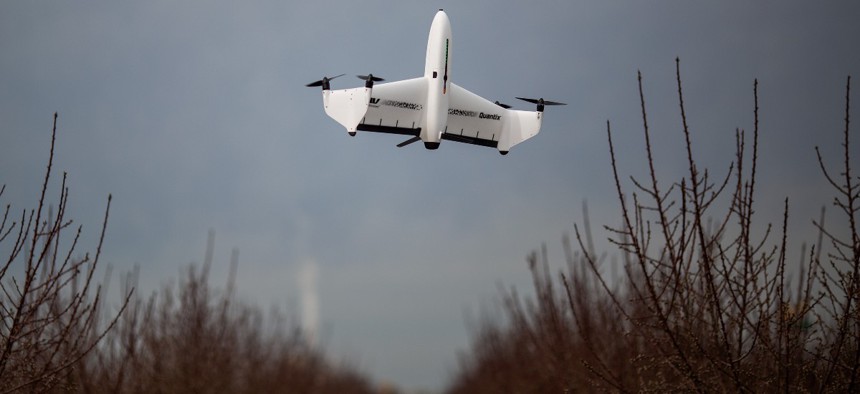
A Quantix drone made by AeroVironment being demonstrated annual 52nd World Ag Expo on Feb. 12, 2019 in Tulare, California. Photo by David McNew / Getty Images

 By
Ross Wilkers
By
Ross Wilkers
At an investor open house event, AeroVironment executives lay out the this new phase of its strategy that includes a focus on production quantities and unifying different systems in the field.
AeroVironment is staking its future prospects on a defense technology landscape where more prime contractors enter the field and spending priorities shift toward systems with artificial intelligence at their center.
Two cases in point are worth highlighting. One is AeroVironment itself and its $4.1 billion all-stock acquisition of BlueHalo, made with the goal of building a more complete lineup of systems and other offerings.
Number two is how Ukraine has defended itself against Russia for the past three-and-a-half years, especially through the use of cheap drones that are not made to last in the field. But that is the entire point of doing so: warfare on a different economic model versus one dependent on big systems.
During AeroVironment’s Sept. 30 investor open house conference, chief executive Wahid Nawabi put some figures to that concept when explaining how Ukraine is informing strategies at companies like AeroVironment.
Nawabi told the audience that at least 1,200 of AeroVironment’s Puma unmanned aircraft are operating in Ukraine today to represent a “significant portion” of the country’s entire intelligence, surveillance and reconnaissance assets.
“Every time that they lose one of these, the economic equation works in favor of Ukraine because the missile used to destroy one of these or defeat one of these costs way more than the drone itself,” Nawabi said.
Production quantities and per unit costs go hand-in-hand for every defense system regardless of size or complexity. AeroVironment certainly wants to be on the side of making more things that are less expensive.
Nawabi said AeroVironment is largely accomplishing that by first developing a product under a joint development effort between company and customer, then transition the item to “some point of commerciality.”
“Almost all of our small UAS today is a commercial item. We published a price list as a catalog, and we sell the customer, we don't have to provide cost justifications,” Nawabi said, adding the majority of its flagship Switchblade loitering munitions are sold that way.
“The BlueHalo products, which are a little earlier in transition from development to production, are following the same exact sort of scenario or movie,” Nawabi added.
Software is also part of the conversation about the cost and efficiency of systems operating in the field, and a big factor in AeroVironment’s thinking behind the BlueHalo purchase.
BlueHalo leaned heavily on software development practices in designing its technology offerings for space, countering uncrewed systems, directed energy and electronic warfare.
Scott Bowman, AeroVironment’s chief technology officer, said the combined company's tech approach is to create a more unified ecosystem that brings together different pieces of software.
The company is focused on “doing that within our own platform first and proving to ourselves that (it) is integrate-able at that boundary before going external with it,” Bowman said. “Where a lot of companies break down and have issues is when they think they have a nicely tested interface, that they've never really done it at scale, and it is when the integration of falls apart.”
For a company like AeroVironment, it can often find itself partnering with and sometimes competing against many of the venture capital-backed startups and larger commercial tech companies. AeroVironment also works with and bids against the larger defense primes from time to time.
Nawabi said that development comes from what he called “a new set of qualifications and attributes that are becoming more important,” including agility and commerciality.
AeroVironment opened for business in 1971, but the more modern iteration of the company traces back to its 2007 initial public offering. Nawabi said AeroVironment has been working on its strategy for focusing on robotic systems ever since that IPO with a belief that Pentagon spending on them would rise.
If Nawabi’s forecast he offered to investors is correct, spending on those systems could easily “triple (or) quadruple in dollars over the next three-to-five years.”
Which should, in theory, mean plenty of market share for AeroVironment and the field to pursue.
Nawabi’s other major prediction he offered attendees was that there would be multiple winners in such an environment.
Such winners will “have the proven ability to actually cross the chasm and go from prototypes to full-rate production, have the scale to produce in volume,” Nawabi said. “That's a very challenging question because the definition of volume is debatable.
“Are we talking thousands, tens of thousands, hundreds of thousands or millions? And no one really knows exactly, including our customers. But in every category that they're spending money on, it's going to be orders of magnitude more in the next three-to-five years.
“The winners (are) the folks that are positioned and prepared and qualified, the best that has those attributes and has systems that are relevant in the fights, that is actually effective in the field, have the ability to scale and produce those, are probably going to have the highest chance of success and a larger share of the wallet of the spend.”