
General Dynamics IT opens new hub for developing tactical edge solutions
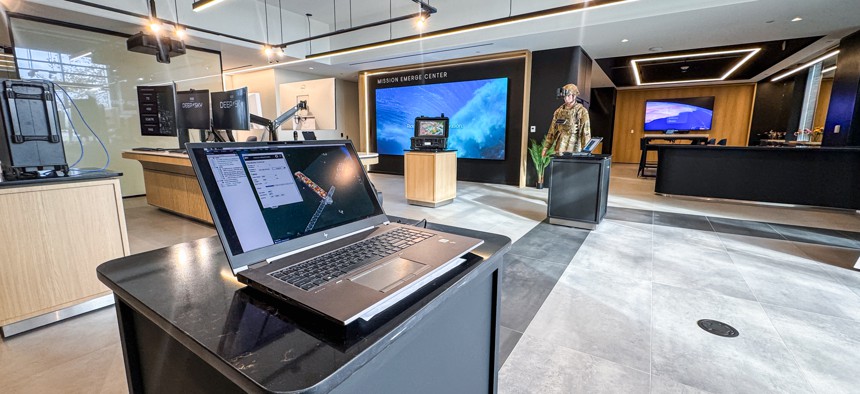
A view inside GDIT's Mission Emerge Center in Springfield, Virginia. General Dynamics

 By
Nick Wakeman
By
Nick Wakeman
The new Mission Emerge Center is GDIT’s newest investment in its research-and-development infrastructure for bringing new technologies to defense and intelligence agencies.
General Dynamics IT has added another “emerge” center to the group of facilities it uses to collaborate and develop new solutions with its customers and partners.
The Mission Emerge Center in Springfield, Virginia, is designed for rapid prototyping and validation of advanced technology solutions for intelligence and defense missions. Mission Emerge joins a group of other GDIT centers focused on innovation, cybersecurity, 5G and wireless technologies.
The mission center also adds a second DeepSky Lab that GDIT developed for working with the National Geospatial-Intelligence Agency. The first DeepSky Lab is near NGA’s western headquarters in St. Louis.
GDIT launched its tech innovation strategy in 2023, including the centers.
"It really changed our focus as a business and how we pursue new opportunities as well as who we deliver for our customers,” GDIT President Amy Gilliland during a briefing at the Springfield center.
Gilliland did not talk about finances, but said the business has performed well over the last few years.
“I credit that to our strategy and the investments we’re making. It really is about listening to your customers and understanding what they want,” she said. “We know the mission. We understand the customer. We sit alongside them whether it is forward deployed or here in a SCIF,” she said.
But what the customer wants is evolving rapidly and that is being driven by lessons coming out of Ukraine and the Middle East, as well as from challenges in the Pacific with China.
“What the customer is telling us now is that we need to anticipate what is coming next,” Gilliland said. “That anticipatory piece is part of the investment we are making because if you don’t invest ahead of time by definition, you’ll be late.”
The Springfield, Virginia facility spans 5,200 square feet and represents GDIT’s latest investment in its R&D infrastructure. The center will serve as a collaboration hub for GDIT teams to collaborate with customers, commercial tech partners and other parts of the broader company.
Over the last decade, General Dynamics Corp. has invested $12 billion in research-and-development.
One example of work at the center that Gilliland cited is its collaboration with Amazon Web Services on an artificial intelligence solution called Dogma.
"From a drone perspective it will allow you to detect targets like drones faster so that you can make decision like which ones to shoot down and which ones might be a friendly asset,” she said.
In one exercise, what used to take 30 minutes to tag all of the drones in an environment took 30 seconds with Dogma.
“We are continuing to evolve that and now it’s three seconds," she said.
On another project, GDIT is working with Google to develop a Google Cloud-in-a-box.
"We worked with them to integrate into that box, AI, cyber and everything that you need at the edge to run applications and collaborate,” she said.
GDIT and Google worked together on Guam to test the solution as part of the Mobility Guardian exercise.
“The cloud-in-a- box solution is basically a disconnected environment that brings you the infrastructure you need to bring the fight forward,” Gilliland said.
The AWS and Google projects are examples of what Gilliland called “right now technologies,” but the purpose of the GDIT’s centers is to also identify emerging technologies.
“As a business we have to anticipate where the puck is going. We need to be ahead on things like quantum,” she said. “One of our newer partners is a company called IonQ.”
GDIT and IonQ are working together on how quantum can take geospatial imagery and understand what is in it so decisions can be made more quickly and accurately.
“Those are just a couple examples of how we’re working with partners and what we might do in a lab like this,” Gilliland said.