
Trump exec order pushes White House as gatekeeper between contractors and Congress
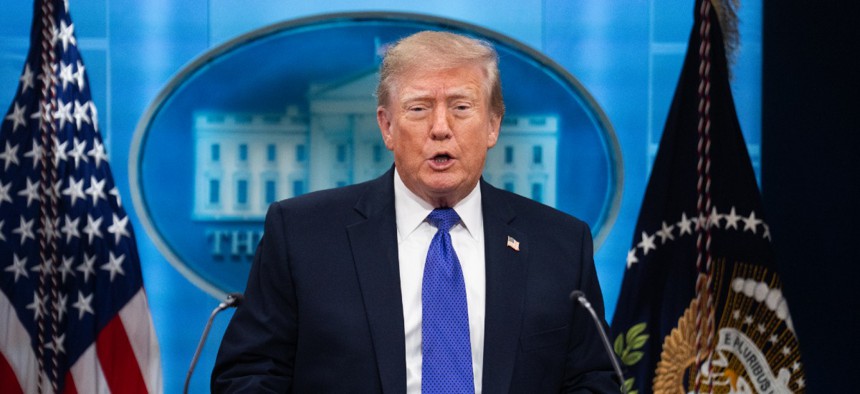
President Trump speaking at a White House briefing on Nov. 20, the same day he signed an executive order to put controls how on contractors interact with Congress. Gettyimagmes.com/ Tom Williams / Contributor

 By
Nick Wakeman
Contractors must report congressional requests and withhold what the administration deems privileged, or risk losing their contracts.
Federal contractors are now required to alert the White House before answering Congress and withhold anything the administration deems privileged, under an executive order President Trump signed Friday as Democrats prepare to take the majority on Capitol Hill.
The White House is couching Executive Order 14438 as a move to protect the executive branch's ability to function.
"The doctrine of executive privilege, which the Supreme Court has recognized is inextricably rooted in the separation of powers under the Constitution, protects confidential executive branch information from disclosure. Protecting this information from unauthorized disclosure, including to members of the Congress, is vital to the functioning of the executive branch," Trump wrote in the order.
Prime contractors and their subs must notify the White House and their customer agencies of any pending or future request from Congress for information about their work with the executive branch.
Contractors also must "abide by any instructions received from the White House and contracting agency related to the withholding of communications that the White House or the agency has determined are protected by executive privilege," the order states.
The order also requires the White House, agencies and contractors to coordinate on responses to congressional requests, including the assertion of any privileges. The Office of Management and Budget is directed to develop guidance on how agencies should ensure their contractors comply.
Agencies are directed to consider suspending or debarring contractors that do not comply, as well as weigh terminating contracts/
A White House fact sheet describes the order as "protecting executive privileges from congressional overreach." The order itself says "certain congressional leaders" have been "harassing private companies that contract with the federal government."
The order is part of a broader White House push to control what reaches Congress. White House Counsel Will Scharf told agencies today hat they must get approval from his office and the Office of Legislative Affairs before agreeing to appear before Congress, the Associated Press reported.
Democrats have vowed to aggressively investigate the administration after they take control of both chambers in January. This includes scrutiny of government contracts and federal money flowing to companies linked to Trump's family.
Other points of friction with the White House include the construction of the new ballroom and the war in Iran. Contractors have played a central role in many of these issues because they won contracts to carry out Trump administration priorities.
Jessica Tillipman, associate dean for government procurement law studies at the George Washington University Law School, believes the order may be on shaky legal ground.
She has written a commentary criticizing the executive order that has been published across the GovExec brands, including Washington Technology.
"Given that transparency in government contract spending is a foundational underpinning of the federal procurement system, the administration is on weak legal footing when a contractor gives Congress nonprivileged information about potential misconduct in public spending," Tillipman writes.
Tillipman points to the D.C. Circuit's ruling in United States v. Navarro, which held that only the president or an authorized representative can invoke the presidential communications privilege.
By contrast, the executive order lets agencies decide what is privileged. A contractor that withholds subpoenaed information at an agency's direction without a valid privilege claim risks being held in contempt, she argues.
Contractors face the dilemma of managing competing demands from the White House and from Congress, according to a memo from Crowell & Moring.
"The EO, which will likely face court challenges, has little precedent in the government contracting field and will force contractors to grapple with how the EO is to be understood in light of existing laws mandating cooperation with Congress," the Crowell & Moring attorneys write.
Congressional committees can hold companies in contempt if they do no not comply with requests for information or subpoenas to testify. But criminal contempt of Congress cases are referred to the Justice Department for prosecution, which puts the decision in the hands of the executive branch.
Tillman writes that is one reason contractors are likely to fear the White House more than Congress, "because the executive branch can punish a company first, long before any contempt case can be resolved."
Contractors are now in an "impossible position of choosing between an existential risk to the business today and contempt proceedings tomorrow," Tillman writes.
NEXT STORY: SAIC promotes Little to group president role