GAO backs Army’s sole-source extension to KBR’s LOGCAP contract
Gettyimages.com/ Cavan Images

 By
Nick Wakeman
By
Nick Wakeman
A challenge by an Amentum-Parsons joint venture fell short after the Government Accountability Office found the Army’s justification for a $3.1 billion extension as reasonable.
A joint venture led by Amentum and Parsons could not convince the Government Accountability Office to stop the Army from extending a LOGCAP V contract held by KBR.
The Army awarded the LOCGAP V vehicle in 2019 by assigning the winners different regions of responsibility.
KBR won the contracts for European Command, Northern Command and Afghanistan. The Amentum-Parsons Logistics Services LLC venture won the contract for Southern Command.
The Army uses LOGCAP to outsource a wide range of logistics services such as facility maintenance, power generation and transportation.
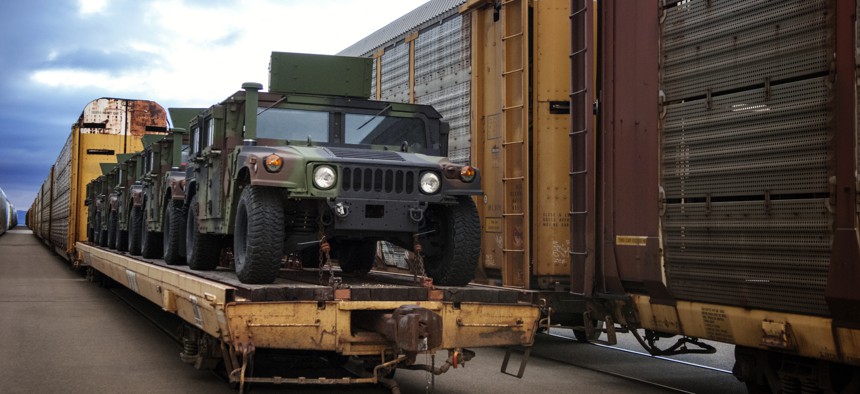
LOGCAP also supports the maintenance and servicing of pre-positioned military vehicles and equipment that are stored in various regions around the world. This equipment is known as Army Pre-positioned Stock or APS.
The Amentum-Parsons joint venture filed a protest with GAO after the Army extended KBR’s contract for EUCOM by another five option years, at a value of $3.1 billion. The JV said the Army did not properly justify the sole-source extension, according to the GAO decision unsealed Tuesday.
The JV claimed that not only was the Army’s analysis exaggerated and inconsistent, the sole-source extension bypassed the planned competition for LOGCAP VI. Event before this extension, the Army had already added a significant amount of sole-source work to KBR’s contract.
One complicating factor for the LOGCAP program and the upcoming recompete is that the Army ran a competition in 2024 among the current primes for APS support. The Amentum-Parsons JV won three of those task orders, which kicked off several protests. GAO ruled in favor of the protesters.
The Army has to run a new competition for what it is calling "LOGCAP V.V," which reads as 5.5.
The protests caused delays that essentially blew up the Army’s timeline for the next iteration of LOGCAP, which forced the Army to extend KBR’s contract.
GAO ruled the Army had documented legitimate concerns such as transition costs, delayed access to LOGCAP VI and administrative resource constraints.
GAO also cited the original LOGCAP V solicitation that said the Army could take noncompetitive actions that could grow the scope of the contracts, which is exactly what happened with KBR and the EUCOM contract.