
GSA’s centralization push is a return to its roots, not just a Trump priority
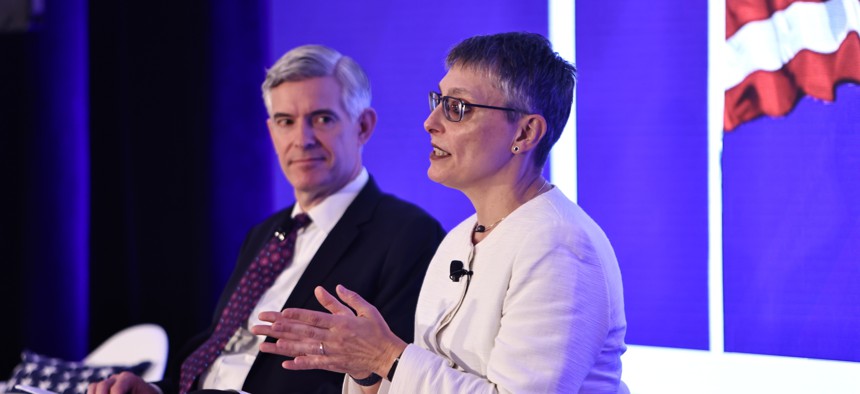
"We have to understand the demand for common goods and services across the agencies, so data becomes key," said Laura Stanton, acting commissioner of GSA's Federal Acquisition Service, during a Q&A with SAP executive Keith Murphy, at Wednesday's SAP NOW event. GovExec

 By
Nick Wakeman
By
Nick Wakeman
The General Services Administration's acting acquisition chief says the consolidation drive mirrors the founding mission laid out by the Hoover Commission 77 years ago.
The General Services Administration’s push to centralize government buying is as much a return to its roots as it is a Trump administration initiative, according to one of the leading architects of the consolidation.
Laura Stanton, acting commissioner for GSA’s Federal Acquisition Service, gave a bit of a history lesson during remarks at the GovExec-produced SAP NOW event on Wednesday in Washington, D.C. GSA started in 1949 as part of a series of recommendations from the Hoover Commission.
“The reasons we were founded as agency are the same reasons and the priorities that I’m going to talk about today,” Stanton said. “Going back to those founding principles is really important to understanding where GSA is and what we’re doing.”
GSA wants to consolidate more government buying through its vehicles. There is plenty of room for that growth with GSA contracts accounting for about 25% total government buying. In 2025, $110 billion in order volume flowed through GSA vehicles.
“That’s a great baseline, but I also think that it’s an indication that we still have a lot of decentralization across the government,” Stanton said.
GSA has long had its Assisted Acquisition Services, but that organization concentrates on contracts and task orders exceeding $50 million.
“There are lot of common goods and services that everybody needs to deliver everyday that are far below that level,” Stanton said.
To fill that niche, GSA created the Office of Centralized Acquisition Services. A lot of routine buying was happening agency-by-agency.
Stanton said that agency-by-agency buying led to inconsistent pricing, duplicative contracts for the same items and negotiations that left money on the table.
OCAS will step into the void and manage actual transactions, not just create master contracts. The theory is that by aggregating demand across agencies, GSA can negotiate better and drive consistency in pricing.
“This means we have to understand the demand for common goods and services across the agencies, so data becomes key,” she said.
OCAS is already working with the Small Business Administration, Office of Personnel Management, other smaller agencies and a few larger ones on the acquisitions of common goods and services.
The office is in a growth mode and Stanton recommended that industry get to know them through their quarterly pipeline reviews.
“You can hear directly about what’s going on in that group and you can figure out how to align to the needs they are articulating,” she said.
OCAS will act as a shared services center actually executing transactions, not just as a contract vehicle shop.
“The more that we’re able to bring into the centralized acquisition group, the more we can begin to work at scale and get those benefits for the federal government at the task order level, not just at the master contract level,” Stanton said.
NEXT STORY: Widepoint wins $3B DHS mobility recompete