
How 20 airports are avoiding spring break security lines
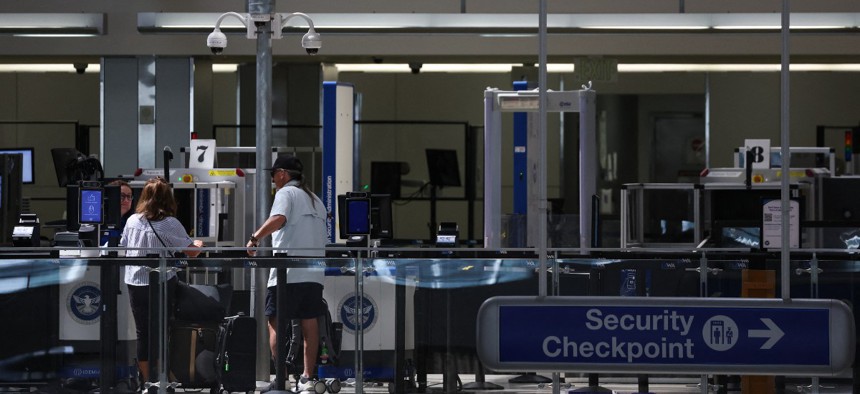
A Transportation Security Administration checkpoint inside Los Angeles International Airport on March 23. Photo by Patrick T. Fallon / AFP via Getty Images

 By
Jim Carroll
By
Jim Carroll
Jim Carroll, CEO of the Professional Services Council, highlights the Transportation Security Agency's Screening Partnership Program as a model for future collaboration between government and industry.
Spring break is supposed to start the moment travelers leave the house — not grind to a halt before they ever reach their gate.
But for millions of Americans heading to the airport this month their vacation is getting stopped at the security checkpoint. Lines with wait times of two hours or more are creating frustrated travelers, forcing families to miss flights, and turning spring break into a headache.
The current Homeland Security Department funding crisis is shining a harsh light on the Transportation Security Agency's operations at airports across the country.
But under this scrutiny, we are seeing a success story. At airports where TSA is supported by federal contractors, lines are moving and travelers are making their way to their destinations on time.
TSA officers are dedicated public servants, but throughout the shutdown missed paychecks have forced many to look for other ways to make ends meet. Officers have had to make difficult choices — picking up other work, missing shifts, or leaving the job altogether.
This impacts travelers because fewer TSA officers working at airports means understaffed checkpoints, fewer lanes open to safely and efficiently screen passengers, and in the worst cases lines that can take hours – meaning missed flights.
But here's what the shutdown is also revealing: some airports aren't experiencing any of these delays. Some airports are continuing to support a record number of travelers. Some airports are making sure that you make it to your destination by providing you with an easy, efficient, and secure screening process — because they have the support of federal contractors.
Twenty airports across the country participate in TSA's Screening Partnership Program (SPP), which contracts qualified private companies to handle security screening under full federal oversight. San Francisco International Airport — one of the busiest airports in the country — participates in the SPP and has seen normal wait times throughout the shutdown.
And there's another benefit that often goes unnoticed: SPP airports have demonstrated real savings for the taxpayer, with government contractors providing the same security and efficiency as TSA but for a lower cost.
This approach isn't new – and there are success stories across the federal government to prove its effectiveness. Contractors provide the surge capacity that keeps critical operations running when they are most needed. Think of the IT specialists that secure government networks, the logistics professionals who support military operations overseas, and the analysts that process sensitive data around the clock – many of whom are federal contractors.
By partnering with private industry, the federal government ensures that they are using the best service providers and technology for the mission at hand.
At nearly two dozen airports across the country, the SPP program works by doing exactly that – giving the federal government the support needed to ensure that there is both efficiency and continuity.
The TSA Federal Security Director remains in charge, but contractors support the mission, following standard operating procedures, protocols, and policies. The TSA crisis is giving us the opportunity to examine how we run airport security across the country.
It might be too late for spring break, but with the help of federal contractors and the expansion of the Screening Partnership Program, we might be ready for summer vacation.
Jim Carroll is CEO of the Professional Services Council, a trade association representing approximately 400 government contractors.