
In a show-me market, Leidos continues to show up
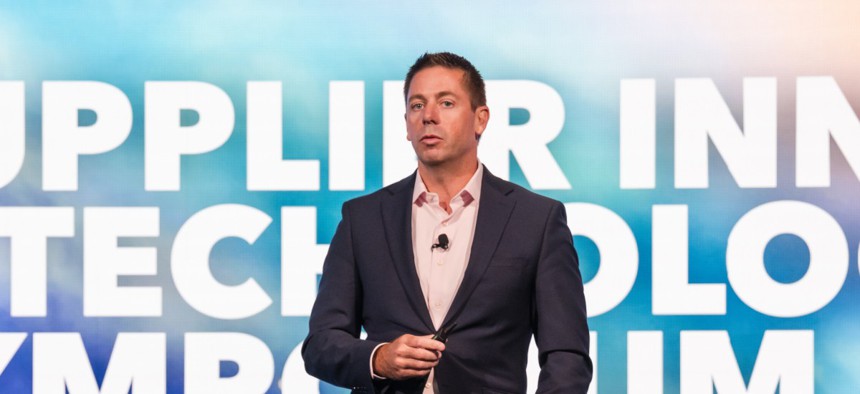
Leidos Chief Growth Office Jason Albanese speaking at the company's 2025 suppliers forum. Leidos

 By
Nick Wakeman
By
Nick Wakeman
The Top 100’s perennial No. 1 company says demonstrated capability – not PowerPoint decks – is the key to winning business today.
It took just 30 days for Leidos to go from first conversations with the Defense Department to signing a customer agreement to develop a new cruise missile variant.
The company’s internal agility was needed to match the military’s need for a lower-cost munition that can be fielded quickly.
For Leidos’ chief growth officer Jason Albanese, the Low-Cost Containerized Missiles program is an example of how both the market has changed and the company had to change along with it.
“Our customers are in a show me mentality, not PowerPoint, not white papers, but show me your capability,” Albanese told Washington Technology. “You have to show up with real capability because they are moving fast when they find something they want.”
That alignment between customer urgency and Leidos' capabilities did not happen by accident.
Leidos unveiled its North Star 2030 strategy in 2024 and placed deliberate bets on specific markets — defense tech, energy, cyber, and space. The current administration's priorities landed almost exactly on top of them.
"A lot of times in our industry, you have to place big bets early and hope they pay off," Albanese said. "What we've seen transpire since then is really clear alignment between our strategy and where this administration is going."
Agility, not just size, has been a key to Leidos’ run as Company No. 1 company on the Washington Technology Top 100 for eight years in a row.
For Albanese, the focus on what he called the “softer” things is what is crucial in today’s market.
“The mindset across the entire company is a productive sense of urgency,” he said. “We all need to be operating faster.”
Sometimes that can mean long hours and working weekends.
“But the other thing that has allowed us to move quickly with our customers is being easy to work with.”
Understanding what the administration wants and what it is trying accomplish is crucial and helped Leidos make its plans ahead of need.
“Our customers have been asking us to put some skin in the game and build capacity and capability before the RFP (request for proposals),” he said. “Companies that lean forward and partner with the customer that are going to move faster.”
A second example from Leidos’ defense tech business is the Dark Eagle hypersonic weapon program, which transitioned from an Other Transaction Authority prototype to a $2.7 billion production contract awarded in May.
“That’s an example of us and our customer going through the research and development and proving that the capability is there,” Albanese said. “We are investing our own money where we feel most confident in that payoff.”
The Low-Cost Containerized Missiles program also illustrates that same commitment, but with the outcome still unwritten.
Leidos is using its own money to prepare for a flight test next year. If the test fails, that investment is gone.
"We are investing to get to the test flight on our own money," Albanese said. "If we're successful with that flight test, what comes on the heels of that is additional government funding for testing. And if we're successful there, that's when you end up with the purchase of thousands of missiles."
It's a calculated risk, but one grounded in what Albanese calls the company's "right to win" — the idea that aspiration alone doe not justify a bet.
"Just because you have the aspiration to want to do something, if you don't have the capability or the right to win, it probably doesn't make good business sense," he said.
CEO Tom Bell has the final approval over these investments.
“You have to explain why it makes strategic sense and need to appropriately weigh the risks,” Albanese said. “The last thing is the business case and why this financially makes sense for Leidos to do.”
Not all the bets pay off, but enough do to keep the needle moving. Leidos recorded $17.2 billion in revenue for calendar year 2026, up from $16.7 billion the year before.
Leidos’ push for capacity and speed also influences its partnerships.
“Partnering has a tremendous amount of value, but it is hard to do well,” Albanese said.
When looking at large companies like Leidos, it is easy to think that it can do everything and partnerships are critical. Part of Albanese’s responsibility as chief growth officer is explain the value of partnerships across the organization.
“Partnerships are a topic with every single bid that we talk about and everything we compete on,” he said. “It’s not just talk about the competition but what’s our differentiation from a partnership perspective.”
Albanese is also focusing on more enterprise-wide partnerships that can have multiple touch points across the organization.
“We're looking for those meaningful partnerships where we can go to market together,” he said. “It's not just one opportunity but multiple opportunities or a market that's mutually beneficial for both of us.”
Companies such as Leidos play a critical role for commercial companies such as Anthropic and OpenAI because of its deep customer knowledge.
“We offer them access because it is what we do day in and day out,” he said. “We have thousands of touch points with the customers they care about every single day.”
Good partnerships across industry also rely on being the partner that is easy to work with, Albanese said.
“When you are trying to go fast on high stakes things, relationships matter,” he said. “Any one of our 51,000 employees can make or break those relationships.”