Leidos' plan for revenue synergies in Entrust acquisition
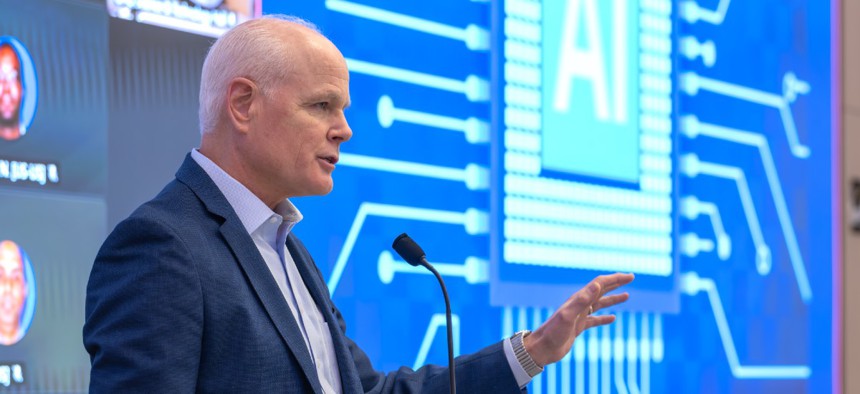
Leidos CEO Tom Bell speaking at Leidos leadership conference in October. Leidos

 By
Nick Wakeman
By
Nick Wakeman
Artificial intelligence tools, new markets and cross-selling are driving Leidos' business case for the $2.4 billion acquisition.
In starting to highlight synergy goals from Leidos' planned $2.4 billion acquisition of Entrust Solutions Group, executives are not talking about sucking costs out of the combined companies by reducing headcount or consolidating facilities.
During a conference call with investors Monday, Leidos executives highlighted opportunities they see in applying artificial intelligence to make the workforce more productive and cross-selling capabilities to each company’s customer base.
Leidos Chief Financial Officer Chris Cage said the use of their Skywire AI platform across the existing energy business has reduced costs by 30%.
“We’ve been a technology company that has been investing in AI-enabled power engineering,” Leidos CEO Tom Bell said on the call. “We feel very good about our opportunity to take those tools into the 3,100 [Entrust] employees and make them ever more efficient.”
Inserting technology in Entrust’s engineering work for utility clients will generate “tens of millions of dollars” in synergies and improve the speed of delivery, Cage said.
The acquisition, expected to close in the second quarter of 2026, brings more scale to Leidos’ energy business as it will double to about $1.3 billion in annual revenue. The energy unit's headcount will grow to 5,500. For 2025, Leidos expects to report overall revenue of about $17 billion.
But scale is just one part of the energy growth strategy. Bell and Cage said that the value will come out of applying Leidos tools to Entrusts customer relationships, as well as gaining access to a gas infrastructure business at Entrust that is new territory for Leidos.
Entrust also does more engineering work on the power generation side of market, while Leidos has focused on the transmission and distribution infrastructure.
“This moves us upstream in the energy value stream into power generation, and it gives us an adjacency into the gas transmission and distribution market,” Bell said. “And those are the key synergies that we're excited about.”
Bell also said there are growth opportunities beyond the engineering work, particularly in cybersecurity and IT services, which are core to Leidos' strategy and services that Entrust has not provided to its customers.
"Once you help those customers with their IT infrastructure, then cyber resilience is again very critical and we have tools and techniques to help those customers with that issue," he said.
Leidos plans to finance the acquisition with $500 million in cash it has on hand, plus $1.4 billion in bonds and $500 million in commercial paper that it expects to pay down through 2026.
That structure will leave Leidos with a gross debt ratio of 2.6 times its trailing 12-month EBITDA (earnings before interest, taxes, depreciation, and amortization). That ratio will improve as the commercial paper retires.
The Entrust acquisition is aligned with Leidos’ NorthStar 2030 strategy, which puts energy as one of five pillars of growth for the company. The other pillars are space and maritime, digital modernization and cyber, mission software, and managed health services.
With this being Leidos' largest acquisition since it spent $5 billion on Lockheed Martin’s IT business in 2016, Bell and Cage both said significant buying power remains on the balance sheet.
"We're not foreshadowing a next move here, but we're saying that we're not locked out of anything else that we find that could help accelerate the NorthStar 2030 strategy,” Cage said.
Leidos' advisers for the transaction are Citi Davis Polk & Wardwell LLP and PwC. Houlihan Lokey, Perella Weinberg Partners, Ropes & Gray and KPMG are the advisers to Entrust and Kohlberg.