SpaceX’s biggest risk factor might be Elon Musk
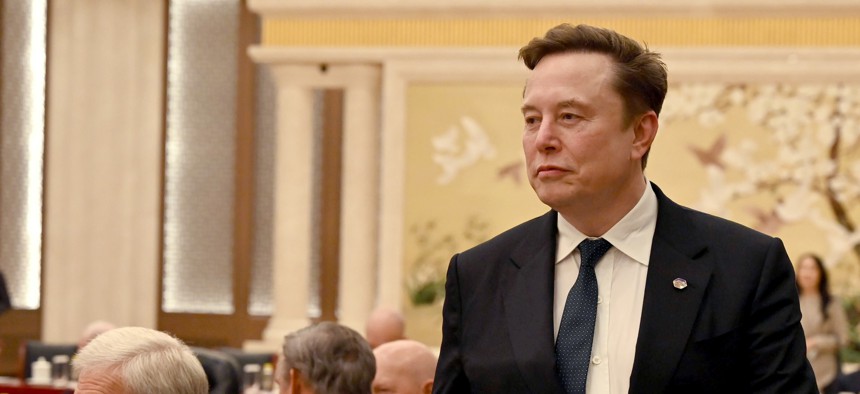
Elon Musk in China where he was part of a business delegation that accompanied President Trump on his visit to China. Gettyimages.com/picture alliance / Contributor

 By
Nick Wakeman
By
Nick Wakeman
ANALYSIS: The company's S-1 filing reveals how the founder's outside entanglements — from DOGE to Brazil — could threaten its government business.
Every S-1 filing by a company entering the public markets includes a section that outlines risk factors the company will face.
Often these are boilerplate types of statements. For companies with significant government business, this includes the risk of government customers canceling or not renewing contracts.
The S-1 filed Wednesday by SpaceX includes many of these kinds of statements, but the company also disclosed many unique risk factors, many of which involve its majority owner and founder, Elon Musk.
These risk factors include Musk’s focus on other companies such as Tesla, Neuralink and the Boring Company, as well as his former role of senior advisor to President Donald Trump, which are examples of how Musk’s attention gets diverted from his role at SpaceX.
Another risk factor is the criticality of Musk’s involvement at SpaceX where he is CEO and chief technology officer.
While Musk is described in the S-1 as the “driving force behind our growth, innovation, and operational success,” the company does not carry any “key person insurance” on him.
“The loss of Mr. Musk, whether due to death, disability, or otherwise, or his inability or unwillingness to continue in his current roles, could significantly disrupt our management structure, adversely affect our ability to execute our strategic plans, and negatively impact our reputation and relationships with customers, partners, and other stakeholders,” the company states in the S-1.
But Musk's outside entanglements carry their own risks, separate from the question of whether he stays. While the filing stops short of naming Musk’s DOGE involvement as a risk factor, it is hard to untangle Musk’s personally close relationship with the Trump administration from the importance of the federal market for SpaceX’s government business.
The filing also acknowledges that SpaceX's deep ties to the U.S. government cut both ways.
If the relationship with the Trump administration sours, it could have an adverse effect on SpaceX's U.S. government business, which comprises roughly a fifth of the company's revenue.
At the same time, the company warns that it 'may be perceived as closely aligned with the U.S. government or military,' which could discourage foreign governments and commercial customers from buying its products and services — and could 'adversely affect our sales in the United States and internationally.'"
The risks tied to Musk's outside relationships are not hypothetical. In 2024, a Brazilian court offered a preview of how those entanglements can spill over into SpaceX's operations in ways the company cannot control.
In 2023, the Brazilian congress, presidential palace, and supreme court were stormed by supporters of former President Jair Bolsonaro. Social media platforms, including X, allegedly were used to plan the attack. X was owned by Musk at the time but was not part of SpaceX as it is now.
The Brazilian courts ordered that X suspend several accounts, and then Musk went on the platform saying he would defy the order and continued sustained attacks on Brazilian Supreme Federal Court Judge Alexandre de Moraes. Musk called him “the charlatan in judges robes.”
Moraes opened an investigation into Musk focused on the dissemination of misinformation and supporting criminal activity, i.e., the attack on the Brazilian congress and Musk’s support for former Brazilian president Jair Bolsonaro.
The conflict led the Brazilian Supreme Court to freeze Starlink’s financial assets and ordered internet providers to block access to X. Eventually, the Brazilian government seized $3.3 million from Starlink and X.
The risk factors section of the S-1 acknowledges the episode directly, warning that SpaceX "may be subject to actions like the Brazil Asset Seizure in the future" — and that such actions may come "whether or not consistent with local and international law."
For the government contractors who compete with and partner with SpaceX, it is a reminder that Musk's outside conduct is now formally a business risk — one that a public company is obligated to disclose to its shareholders.