
FDIC surveys landscape for IT consolidation approaches
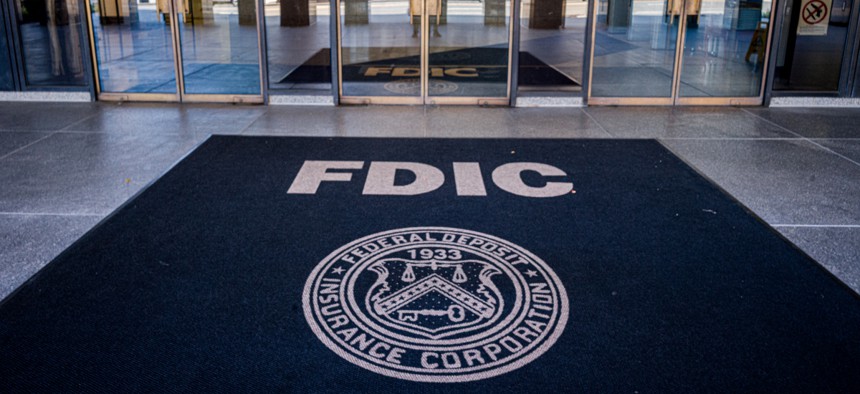
The front door to the Federal Deposit Insurance Corp.'s headquarters in Washington, D.C. Photo by J. David Ake / Getty Images

 By
Ross Wilkers
Artificial intelligence and conventional automation techniques are a keen area of interest for the government body chartered to protect U.S. citizens' savings accounts.
The Federal Deposit Insurance Corp. has embarked on initial market research efforts to inform its work on creating a new technology and professional services contract to support FDIC’s office of the chief information officer.
FDIC is exploring industry approaches for consolidating and modernizing IT systems across functional areas such as human resources, facilities management, acquisition, learning and development, crisis readiness and response, and physical security.
FDIC particularly wants to know where artificial intelligence and conventional automation techniques can work with human expertise to help the agency improve interoperability and decision support, the agency said in a Friday Sam.gov notice.
The request for information uses the term “Super Intelligence” to describe AI, per President Trump’s September executive order mandating agencies use SI in official communications as opposed to AI.
FDIC describes its current IT environment as including IBM Tririga and Maximo for facilities management, an Appian-based platform for acquisition processes, ServiceNow, Revit and other enterprise systems.
Responses to the RFI do not have to presume that existing operating models, processes, methods, workflows or technologies must be retained or replicated.
The agency is specifically asking for ideas on how to incorporate AI into its workflows and overall operations in areas such as case and document management, system integration, data governance, analytics, reporting and decision-making.
FDIC also wants interested parties to address human oversight, security, auditability and other controls that should be implemented along with AI capabilities.
Responses may not exceed 20 pages and contain details on solution architecture, implementation and sequencing, integration, data migration, licensing, operations, and sustainment. The agency is also asking for non-binding cost estimates and details on consolidated licensing models that can be deployed on expedited timelines.
Responses to the RFI are due by 9 a.m. Eastern time on Oct. 26.