
More satellites will not save us
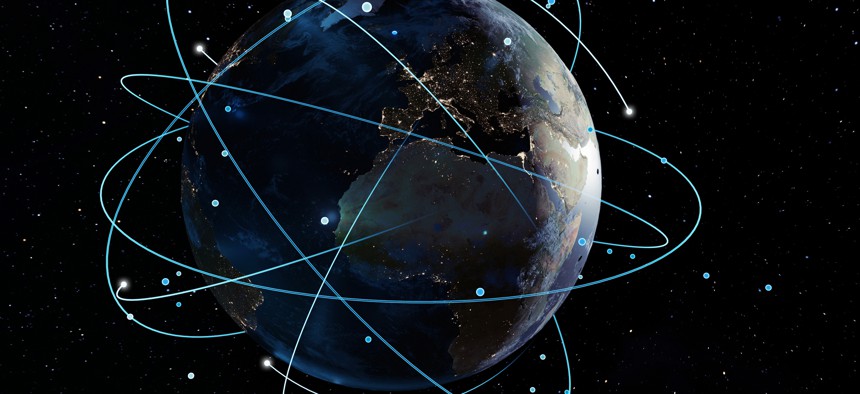
Gettyimages.com/ Alones Creative

 By
Graeme Ritchie
By
Graeme Ritchie
The West is winning the numbers game in space but is missing the point. Real resilience depends on autonomy and ground-segment survivability, writes Graeme Ritchie, CEO of Shield Space.
A consensus has settled across Western defense establishments that if we proliferate, we will survive.
Launch more satellites, build them cheaper, replace them faster, and make the adversary's targeting problem so costly and so complex that attacking a constellation is strategically irrational.
But this approach is insufficient by itself, and the gap between what proliferation provides and what operational resilience requires is wide enough to risk a catastrophic failure of Western space power.
The core confusion is between survivability and resilience.
Survivability is about how many satellites remain intact after an opening attack and resilience is about whether those satellites, together with the ground infrastructure, the operators, the data links, and the decision-making processes on which they depend, can still function well enough to support military operations under sustained disruption.
Numbers address the first problem almost entirely; the second, barely at all.
Every constellation is anchored to a small number of fixed, known, commercially operated ground stations. This ground segment is the single point of failure that satellite numbers cannot compensate for, and in a conflict, an adversary who understands operational priorities will not begin by attempting to shoot down five hundred spacecraft. They will begin by targeting the infrastructure on which those spacecrafts depend.
We have seen this in Ukraine extensively where electronic warfare systems have consistently targeted the RF links on which Starlink depends rather than the satellites themselves, causing tactical disruption at a fraction of the cost and well below the escalatory threshold that a kinetic anti-satellite strike would trigger.
The 2022 Viasat KA-SAT cyberattack, executed in the first hours of the invasion, propagated through the ground segment to neutralize tens of thousands of terminals without touching a single satellite. The constellation survived. However, the operational capability it was supposed to provide did not.
Even a fully intact proliferated constellation can fail operationally if the architecture lacks the autonomous coordination to exploit it. Managing several hundred spacecraft in a contested theater produces cognitive loads that human operators working from fixed ground segments cannot feasibly sustain.
The bottleneck is not bandwidth but cognition, and the result in a high-tempo conflict will not be spectacular failure but entropic degradation, slower decisions, erratic prioritization, and an intelligence picture that lags behind the operational situation by just enough to be tactically useless.
The deeper problem is that most proliferated architectures still assume semi-permissive conditions; partial ground contact, some coherent command authority, manageable levels of interference. An adversary will calibrate their attacks and shape the battlespace to degrade the ground segment to precisely the level that prevents coherent operation while remaining below the threshold that would trigger a kinetic response.
Therefore, satellites that cannot operate effectively in genuine blackout conditions are not resilient by any meaningful definition. They are ground-dependent systems that happen to be in space.
In comparison, autonomous mission management at edge, offers the ability of a spacecraft to self-task based on theater-level mission parameters, coordinate laterally with adjacent nodes, adapt to degraded states, and continue providing useful output without ground intervention, is what turns a collection of orbiting hardware into an operationally resilient system.
The answer is not fewer satellites but a fundamentally different conception of what makes a space architecture resilient. That conception begins with heterogeneous architectures that span across multiple orbital regimes, frequency bands, ground segment geometries, allowing national operators to impose a genuinely complex targeting problem on the adversary, not just a large one.
A federated architecture with genuinely independent failure modes is harder to attack systematically and neutralise completely.
Noting that, it also requires maneuver. A satellite capable of varying its orbital parameters, altering its observational geometry, and relocating away from a threat without waiting for ground authorization presents a fundamentally different targeting challenge than one on a predictable, fixed orbit.
The West is beginning to develop these capabilities at the program level, with emerging U.K. companies such as Shield Space developing the onboard autonomy systems that would allow satellites to detect threats and maneuver in real time without depending on ground-based decision cycles.
Allied coordination remains underinvested, yet a federated architecture in which British, French, Canadian, German, Australian, and Japanese national capabilities are genuinely interoperable would be considerably more resilient than the sum of its national parts.
Building it will require standards, interoperability agreements, and combined doctrine, which is slower and less commercially legible than buying more satellites but represents arguably the single greatest force multiplier available to the alliance.
The current danger for Europe is that proliferation has become a destination rather than a direction, a complete answer rather than one part of it, and that the gap between surviving the first strike and sustaining coherent operations through everything that follows is being systematically ignored.
Space will have its Battle of Britain moment, and that moment will test not how many satellites the West has launched but whether the surviving architecture can still act decisively under pressure, autonomously, rapidly, and without waiting for ground segments that may no longer be available to respond.
Resilience is not a property of satellite count. It is a property of systems designed to keep functioning coherently at the moment when functioning coherently is hardest.
Graeme Ritchie is the CEO of Shield Space, a British defense company specializing in space control and counterspace capabilities.