
Pentagon to become rare earth mining company's largest stockholder
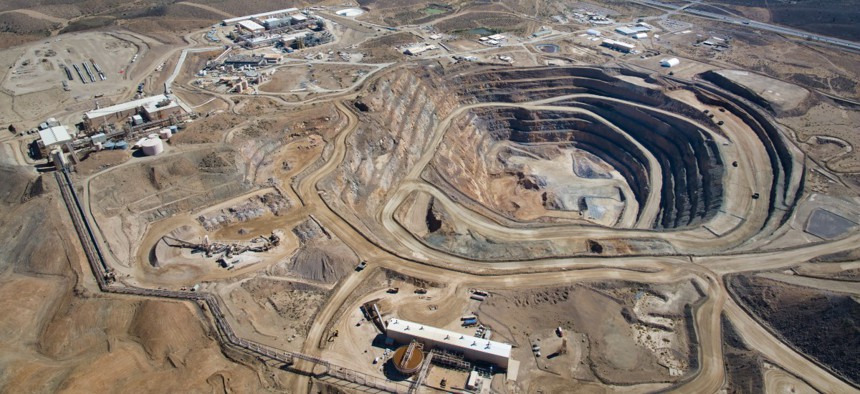
An aerial view of the Mountain Pass, California mine. MP Materials photo.

 By
Ross Wilkers
By
Ross Wilkers
The Defense Department will buy a 15% stake in MP Materials and fund the construction of a magnet-making facility, all with an eye toward breaking the U.S.' reliance on China for rare earths.
Rare earth minerals are not a technology in and of themselves, but are underlying ingredients for some of the most complex systems across the planet including military platforms and automobiles.
Which explains how the U.S. and other countries are concerned about their availability after China started to limit the availability of rare earth exports in April, following President Trump’s placement of higher tariffs on Chinese goods.
China represented approximately 70% of the U.S.’ rare earth imports in 2023, according to U.S. Geological Survey data.
That is the backdrop against which the Defense Department is taking matters into its own hands, agreeing to acquire a 15% stake in MP Materials and become the company’s largest shareholder.
Founded in 2017, MP currently focuses its production on the Neodymium-Praseodymium oxide mineral that is used in high-strength permanent magnets to power complex motors. The company’s Mountain Pass, California mine is currently the U.S.’ only operational hub for deriving rare earths out of.
MP will put much of that capital toward the construction of a second manufacturing facility in the U.S. focused on magnets currently being called 10X. The company is pushing to have that facility online by 2028 and complement the Mountain Pass mine.
As part of the arrangement, DOD also agreed to buy 100% of the magnets made at 10X for the 10 year-period after the plant becomes operational. DOD will buy the Neodymium-Praseodymium oxide minerals from 10X at a minimum price of $110 per kilogram for those 10 years, the department and company said.
It is not lost on either side of the arrangement that China could also fully roll back its export restrictions and flood the global market for minerals, which would cause a supply glut and prices to plummet. China could also stop exporting the materials altogether, which would result in a supply crunch and much higher prices.
During a conference call with investors Thursday, MP’s chief executive James Litinsky described the current landscape as giving Western buyers of the minerals a binary choice of where to go.
“There's the Chinese sphere of influence or there's MP, and so I think that puts us in a really good position,” Litinsky said. “Part of the goal of this transaction is making sure that MP is positioned strong as a national champion with the economic platform to really have the firepower to build this out.”
MP also may only just be the starting point for how DOD is looking at ramping up the domestic production of these magnets and for reasons beyond just the military.
“What DOD is focused on here is not just satisfying their needs, it is focused on ensuring that there is a scaled domestic industry, and that starts with vertical integration at scale,” Litinsky said. “From that perspective, we certainly feel very, very confident that DOD's needs will be met out of this facility, and we believe that there is pretty significant incremental opportunity to bring quite a few commercial businesses into the fold in that facility.”
DOD’s investment in MP comes roughly three months after Interior Secretary Doug Burgum said the Trump administration was considering direct investments in companies that mine and process rare earth minerals. Burgum indicated a sovereign wealth fund was one option to do so, which would go in competition to Chinese state capital.
Below is Litinsky’s appearance on CNBC Thursday to explain the Pentagon’s investment in the company and what comes next.
NEXT STORY: Workday launches government subsidiary