
SAIC's CEO: 'What was defense is now national security'
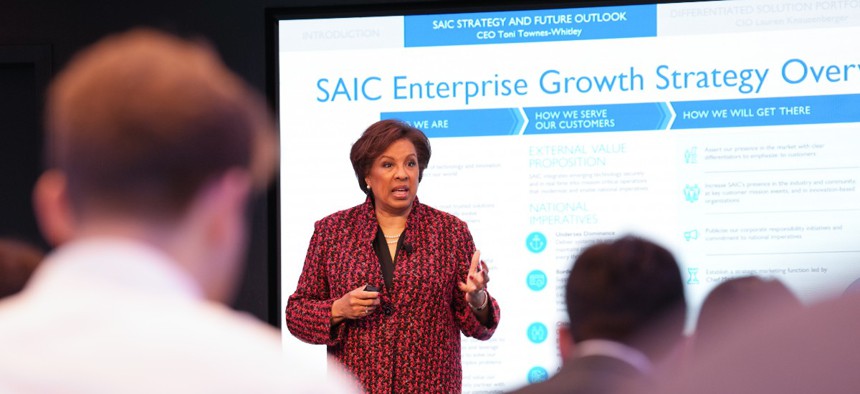
SAIC CEO Toni Townes-Whitley briefs 2024 Investor Day attendees on the company's strategy. Courtesy of SAIC

 By
Ross Wilkers
By
Ross Wilkers
That description also extends to how Toni Townes-Whitley talks about the industry, but with a different word to describe its participants.
Verbiage is supposed to evolve with the times, but the phrase “defense industrial base” has hung around to describe the private sector’s support of its military customer ever since the Cold War began.
But in starting a Thursday talk at the Atlantic Council think tank, Science Applications International Corp.’s chief executive Toni Townes-Whitley seemed to challenge whether the DIB phrase applies in today’s landscape.
“In many ways, our country is part of an emerging national security innovation ecosystem. What was defense is now national security. We’ve moved beyond physical perimeter security of our own borders,” Townes-Whitley said.
As she sees the world, a broader definition of national security is more in vogue with the times. Townes-Whitley sees that scope as including “critical infrastructure, cyber, space and other domains beyond the military services.”
That traditional DIB term certainly held true in a hardware-defined era. Software largely runs the world now, including at many manufacturers that incorporate digital tools and techniques into how they make hardware products and systems.
Hardware makers and software providers are both part of that innovation ecosystem, according to Townes-Whitley.
She added startups, academia, startups, the venture capital community, hyperscale cloud providers (including Microsoft, where she worked before SAIC), and technology integrators like SAIC as in there too.
“The magic and some of the mystery sits in the ability to not only collaborate, but to fundamentally integrate that technology, and that means you have to build in an open system, open architecture so that you can move quickly and no one owns the endgame there,” Townes-Whitley said. “There's no vendor lock in that environment. So that means companies have to make choices and we've been pushing for companies to be held accountable for building in a more open environment.”
Open architectures and open environments are often spoken of from that technology point-of-view she laid out. Those design approaches are intended to allow for the interoperability and customization of components, which can be substituted in and out as technology evolves.
But there also is a business application to take note of from that word “open,” which harkens back to the different types of organizations Townes-Whitley named as part of the innovation ecosystem. It is also the source of her greatest concern about the future.
“It would be the absolute worst time and worst practice of this country to send a signal that only a few players are welcome. I don't care what who the players are,” Townes-Whitley said. “This is a time for open playing field. Demonstrate ahead of time what you can do, show us. Let's get the capital structured and allocated in the right direction and let's move because the adversaries we're facing, that's how they move.
“If we go backwards to some kind of bifurcated new DIB, old DIB, good players, bad players, I think it's shortsighted.”
Below is the full Atlantic Council program featuring Townes-Whitley.