
Leidos CEO: cost, efficiency conversations with customers are shifting
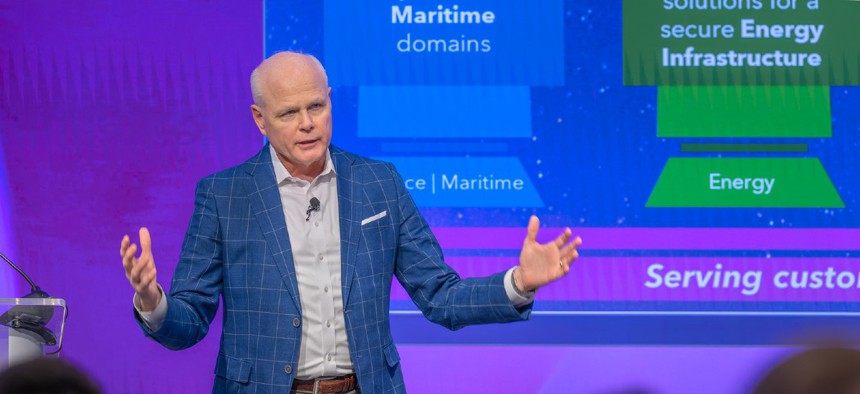
Leidos' CEO Tom Bell speaking at a Town Hall event in May at Leidos' corporate headquarters. Courtesy of Leidos.

 By
Ross Wilkers
By
Ross Wilkers
In talking with Wall Street, Tom Bell says the customer dialogue tide is turning from "simply slash-and-burn" and more toward what the longer term should look like.
Aggressiveness and heavy-handedness represent some of the ways to describe the Trump administration’s push for contract cuts and other categories of savings during its first six months.
The Department of Government Efficiency drove much of that and the influence of DOGE remains a large one over the entire ecosystem, where cost controls remain paramount in communications between contractors and their customers.
During Leidos’ second quarter earnings call with investors Tuesday, chief executive Tom Bell characterized how he sees much of that dialogue shifting here in these summer months versus where it started.
“Cost efficiency is alive and well as a part of this administration, I think now the cabinet level secretaries all have an impetus to save money and have better outcomes,” Bell said. “We see that tide turning from simply slash-and-burn, to now constructive conversations about what better looks like, and how more efficient looks like, and what smarter looks like.”
The first six months of Trump 2.0 was replete with stop-work orders, full or partial terminations of many contracts, and descoping of others. Bell told analysts that “DOGE-inspired pricing reviews” were also part of the government’s renewed scrutiny on contracts and what agencies spend on them.
“While there was a reasonably high slope in that curve during the first half of those six months, here in the last three months that's been flat,” Bell said. “We haven't seen increases and in fact, that's just gross disruptions, not net disruptions.”
For much of that six-month period, Leidos put its own spending control measures in place that Bell referred to as “intelligent austerity measures.”
Chris Cage, Leidos’ chief financial officer, said the company’s senior leadership team laid out that plan to focus investments on core operations and “in our people where appropriate.”
Cage told analysts the company will look to maintain some of the savings it built up from that pullback, but will use the second half to outlay that “tens of millions of dollars of incremental investment.”
“We see that it's time to go back to more normal operations for most of that given where we are in the environment and the opportunities that are coming forward,” Cage said. “We obviously want to turbocharge our (artificial intelligence) adoption, those demo-ready capabilities in maritime and the defense systems space, and with software. Those are our priorities and (we’re) investing in our ‘Golden Bolts.’”
The Leidos Autonomous Vessel Architecture is one of those maritime capabilities Cage referenced. LAVA represents a suite of tools for enabling autonomous navigation, operations and coordination of unmanned surface vessels such as the company’s Sea Archer vehicle.
On the call, Bell said Leidos has deployed the LAVA architecture on 10 vehicles currently in the water and sees that as a platform for doing more with the technology.
“We have a program that we're bringing forward to the Navy that we think combines the need for a quick build of very agile maritime autonomous vessels with the rebuilding of the maritime industrial base in the United States,” Bell said.
Does that mean Leidos will get into the shipbuilding business or the shipyard business? Not in the traditional sense, according to Bell.
“We think there’s ample shipyards in America that can satisfy the need for these medium and small USVs. That's the network we're tapping into to enable them to be a part of the solution around the whole of the nation, as opposed to us buying and/or building shipyards.”
Second quarter revenue of $4.2 billion was up 3% compared to the prior year period, while profit of $647 million represented a 16% year-over-year increase in adjusted EBITDA (earnings before interest, taxes, depreciation and amortization).
Leidos adjusted its full-year sales guidance to between $17 billion and $17.25 billion, compared to the prior $16.9 billion-to-$17.3 billion range. The company nudged up its adjusted EBITDA margin outlook to mid-13% from the prior mid-to-high 12% figure.