
Leidos sounds unfazed by GSA's push to centralize software buys
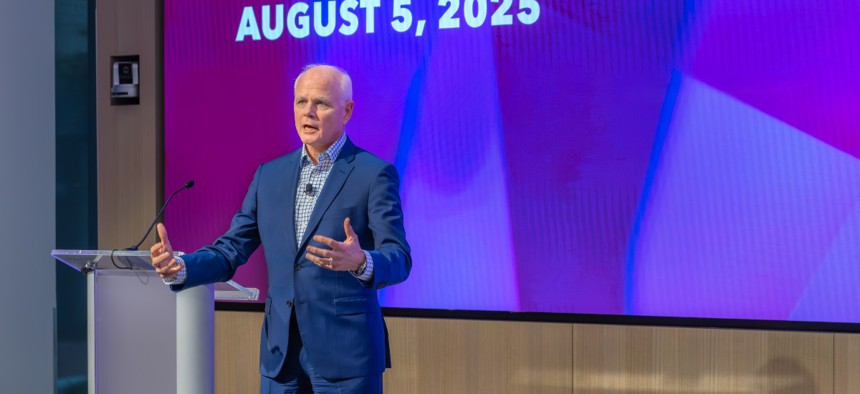
Leidos' CEO Tom Bell speaking at an Aug. 5 Town Hall event at Leidos' corporate headquarters in Reston, Virginia. Leidos

 By
Ross Wilkers
By
Ross Wilkers
As Leidos CEO Tom Bell told a group of reporters, the company is "more interested in the system we can build around all of the widgets" to make technology work better for government.
“Go commercial” is an apt way to describe the direction that the Defense Department and General Services Administration increasingly want to lead the federal government toward in how agencies buy software.
Think DOD’s mandate issued in March to make rapid and commercial-like acquisition approaches the default for purchasing software, as well as GSA’s OneGov initiative for direct agreements with global consumer and enterprise tech companies. President Trump’s executive orders in April on commercial procurements are part of the equation too.
Speaking to reporters on Aug. 7 at Leidos’ supplier symposium, chief executive Tom Bell characterized where he sees the technology and systems integrator in a landscape where commercial and customized software will have to co-exist.
Highly-customized mission software is one of four long-term growth pillars at Leidos, which has also acted as a commercial tech scout and conduit for its government customers over many years.
“That has always been one of our jams. One of the things that we are very proud of is we're ecumenical when it comes to the widget,” Bell said in National Harbor, Maryland. “We're more interested in the system we can build around all the widgets to make a product and capability for a customer better than they can themselves.”
GSA’s push to take on much of the government’s common goods and services purchasing has a heavy emphasis on IT, which includes software and looks poised to eventually include hardware such as laptops. One of GSA’s goals in consolidating software buys under OneGov is to get volume discounts on the items.
Bell said that what a laptop maker sells Leidos the machine for is essentially at the same price the customer then buys it at, but added that is only the starting point.
“You can give somebody a laptop, but it takes somebody to make that laptop work in the environment as a mission systems integrator, which is what we do,” Bell said. “I feel like our value-add is only going to grow because GSA and the whole government is frustrated by the fact that the IT systems of the government are suffering under legacy products and software.”
Given Leidos’ interest in making complex systems work, the company’s watch item list includes the Federal Aviation Administration’s plan for a new air traffic control system and the Golden Dome plan for a nationwide missile defense shield.
A final solicitation could be released any day now for the contract to build the air traffic control system, which Transportation Secretary Sean Duffy said in July will cost $31.5 billion. The FAA did receive an initial $12.5 billion funding allocation for a down payment under the "One, Big, Beautiful Bill.”
The contract is currently structured as one that will hire a lead systems integrator, which Bell said Leidos “would probably” be precluded from because the draft solicitation had language on weeding out organizational conflicts-of-interest from the competition.
OCI issues typically crop up in contracts involving management support, assistance in technical evaluations, and most frequently in systems engineering and technical assistance work.
But that will not leave Leidos out of the air traffic control picture entirely, according to Bell. He said Leidos is looking at opportunities in areas like sensor technology and the common operating picture controllers will need for their jobs.
Then there is Golden Dome, which will also need to have complex software and systems integration work involved along with the hardware. Bell touted Leidos’ tech offerings in counter-unmanned aerial systems, air defenses against cruise missiles, radars and other tools used in border surveillance as what it can bring to bear.
Those are among “the capabilities to know what's happening over the horizon and around the borders of America,” Bell said. “That's very much where we are when it comes to the space layer, having a pervasive understanding of what's coming our way.”
NEXT STORY: Woven Solutions gets private equity backing