
Leidos seeks to be the government's 'beta tester' for artificial intelligence
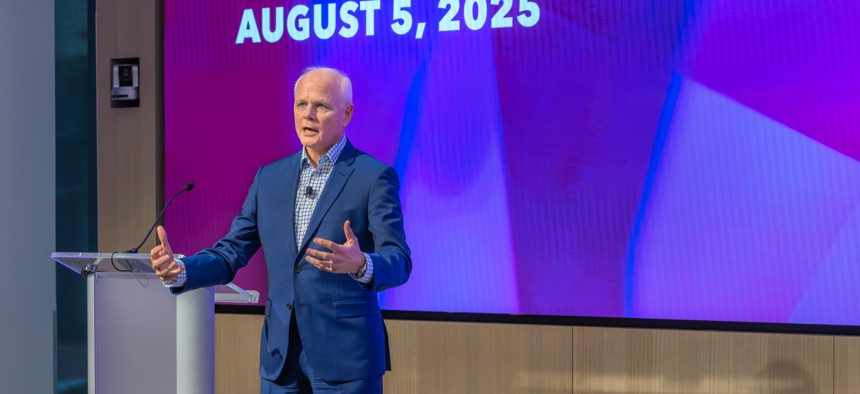
Leidos CEO Tom Bell speaking at a quarterly employee town hall event on Aug. 5. Leidos photo.

 By
Ross Wilkers
By
Ross Wilkers
“We want to look at it, understand it, exploit it and be able to serve our customers with it, no matter which model of AI they want to embrace," CEO Tom Bell tells Wall Street.
In the big world of commercial tech, publicly-traded companies are experiencing downward pressure on their stock amid investor concerns that artificial intelligence is making it easier for companies to develop their own software.
Software-as-a-service models especially are being viewed as ripe for disruption as the likes of OpenAI, Google’s Alphabet parent, Anthropic and others are rolling out models that can help code. Add GitHub into that conversation and it becomes clear as to why investors are asking hard questions.
During Leidos’ fourth quarter and 2025 year-end earnings call with investors, chief executive Tom Bell acknowledged he too is seeing “the stock market effect of the fear of AI overtaking the world and why some people might say that.”
But within the context of Leidos, Bell sees AI as core to what the company has always wanted to do in technology for government customers and itself.
“We continue to lean into all commercial technologies. It is part of the business model that has made Leidos successful, and we don't see AI as being any different,” Bell said. “We want to look at it, understand it, exploit it and be able to serve our customers with it, no matter which model of AI they want to embrace."
“We are very keen to make sure that we are the beta tester of how AI makes organizations faster and more efficient,” Bell added.
Beta testers describe end users that test nearly-complete software, apps or products in real-world conditions before their official release in order to find bugs, assess usability and provide feedback to developers.
These testers essentially act as external evaluators to help development teams fix issues, improve features and ensure reliability.
In April 2024, Bell first unveiled a set of tech priorities for Leidos that would shape what it now calls the NorthStar 2030 strategy and vision for the company. Bell largely described AI as an enabling function for cyber and software, areas that do have some overlap with one another.
As Bell pointed out at the time, the emergence of AI in the federal government landscape followed rapid adoption of those technologies in many commercial industries.
A sizeable portion of that beta testing work resides within Leidos’ digital modernization sector led by President Steve Hull, which delivers tech solutions for customers and houses the company’s functions for internal IT and information security.
Still within Leidos itself, long-time company veteran Will Johnson has moved into a new role as enterprise transformation leader. Johnson previously led Leidos’ federal civilian IT business area and brings 35 years of overall tech experience to the role.
“I'm charging Will with driving significant outcomes in workplace efficiency through business process reengineering unlocked via the power of technology, particularly AI,” Bell said. “Will's mission is to deliver measurable transformational cost reduction outcomes for us and then help transfer them into our customer solutions.”
Leidos’ point-of-view on implementing AI boils down to making sure certain tools and processes work for the company before taking them out to the customer landscape. Bell said the idea is to use them in prototyping efforts with the goal of translating them into revenue opportunities.
“Ultimately, we see AI as an opportunity to help our customers shift budgets away from maintenance and into high-value mission outcomes, which is of course, the business we're in, making their outcomes smarter and more efficient,” Bell said.
Fourth quarter revenue of $4.2 billion was down 3.6% from the prior year period due to the six-week government shutdown, while profit of $556 million showed a 9.4% year-over-year increase in adjusted EBITDA (earnings before interest, taxes, depreciation and amortization).
For the full year 2025, sales of $17.2 billion were up 3.1% from the prior year period and adjusted EBITDA of $2.4 billion showed a 12.4% year-over-year increase. That translates to an adjusted EBITDA margin of 14.1%, up from the 12.9% figure for 2024.
Leidos’ initial guidance for 2026 puts revenue in the range of $17.5 billion-to-$17.9 billion and the adjusted EBITDA margin at mid-13%. This outlook does not include contributions from the pending $2.4 billion acquisition of Entrust Solutions Group, which Leidos expects to complete before the second quarter's end.