
SAIC plans partial pivot away from enterprise IT
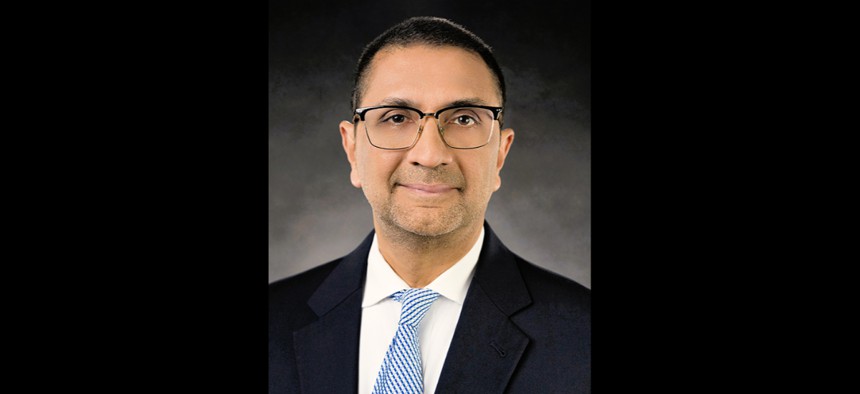
SAIC's chief financial officer Prabu Natarajan. SAIC photo.

 By
Ross Wilkers
By
Ross Wilkers
In talking with investors, SAIC’s chief financial officer Prabu Natarajan lays out how the company sees those opportunities and gives an update on its CEO search.
Science Applications International Corp. is de-prioritizing certain types of enterprise IT contracts amid the company’s ongoing process to hire its next chief executive and larger efforts to reinvigorate organic growth.
Speaking at a TD Cowen-hosted investor conference Wednesday, SAIC’s chief financial officer Prabu Natarajan said the company is not entirely exiting that line of work because not all of those opportunities are exactly alike.
Natarajan said that on the civilian side, agencies are generally more comfortable buying enterprise IT on a firm-fixed-price or time-and-materials basis.
“We make very good margins. It's a win-win, I think, for us and our customers,” Natarajan said at TD Cowen’s 47th Annual Aerospace and Defense Conference.
On the other hand, Natarajan characterized Defense Department agencies as still more comfortable with buying enterprise IT via cost-plus contracts and “are reluctant to go to fixed-price.”
According to Natarajan, that dynamic “makes it harder for (SAIC) to differentiate our offering from somebody else’s offering.”
“If I zoom out just a little bit and look at the history of our recompete losses over the years, the one common thread across most of them has been large EIT, cost-plus and (DOD),” Natarajan said. “To me, I think part of the message today is that we are focused on being more selective. We're not going to walk away from enterprise IT, that is not the message, but ‘Let’s focus on vitamins and not calories’ is a healthy message inside the company.”
Natarajan spoke to investors following SAIC’s release of preliminary unaudited financial results for its fiscal fourth quarter and full fiscal year 2026 ended Jan. 30. These figures represent SAIC’s initial estimates before they undergo examination by an external auditor, a process required of all publicly-traded companies in the U.S.
With the caveat of being subject to change, SAIC estimates it experienced a 6% organic revenue decline in the fourth quarter and 3% for the full year. Reston, Virginia-headquartered SAIC pegs its fiscal 2026 revenue at around $7.26 billion, pending the final audit.
The company previously said it expected to see a 2%-to-3% organic revenue decline for fiscal 2026. SAIC also issued its initial FY 2027 outlook that projects organic sales to be down 2%-to-4%, a reversal from prior guidance of no growth-to-3%.
SAIC will report the audited and final numbers before markets open on March 16, when they will hold a conference call with investors.
SAIC decided to release the first draft of its fiscal 2026 results in light of general procurement delays the company is seeing and a series of key recompete losses.
Natarajan cited two losses in particular: a potential $1.4 billion Army Corps of Engineers task order won by Accenture’s federal arm that SAIC is protesting, and the Air Force’s Cloud One Next program.
Both of those contracts add up to roughly 4% of SAIC’s revenue mix, Natarajan said. Large enterprise IT overall represents about 10% of the company, according to an investor slide deck accompanying the initial financial results.
All of that being said, SAIC’s enterprise IT mix in the civilian segment still contains the Treasury Department’s T-Cloud contract and State Department’s Vanguard program. The latter is being broken out into five different work streams and SAIC is pursuing four of them, Natarajan said.
For civilian agencies, SAIC apparently is finding a more receptive audience for the company’s message on its approach to enterprise IT.
“It is a healthy message that we can communicate to customers to say ‘Look, we want you to transform, we're not here just to run the network,’” Natarajan said. “We need their help to be able to set up contract terms that allow us to bring real automation, real (artificial intelligence), which we're able to do on the (federal civilian) side, but we need to be able to do that because part of what is going on is incumbency risk on enterprise IT contracts.”
So if SAIC is opting to be more selective on enterprise IT pursuits, what will take the place of them as the company pushes to reinvigorate its organic growth engine?
Natarajan said SAIC is reallocating capital toward opportunities in mission IT and engineering, which includes systems engineering and technical assistance.
“To the extent that the customer is on buying new space systems, the SETA work that we do for some of the three-letter agencies really helps us advise the customer on what procurements make sense, what requirements we need to look like,” Natarajan said. “To me, that part of the market is doing pretty well as well, so we've got multiple areas of exposure.”
As far as the CEO search is concerned, Natarajan said to “expect to hear something from us” within the next few quarters. Jim Reagan was appointed interim CEO in October following the departure of Toni Townes-Whitley and is on the search committee.
“I think the board (of directors) is very much of the view that we need an execution-focused CEO that can bring some real shareholder value,” Natarajan said. “I do think that there are some real opportunities in the way of portfolio transformation, but we need somebody permanent in place to be able to navigate the next few steps. But the board is at it, and we'll get there.”