
AEVEX enters water with $600M BlackSea acquisition
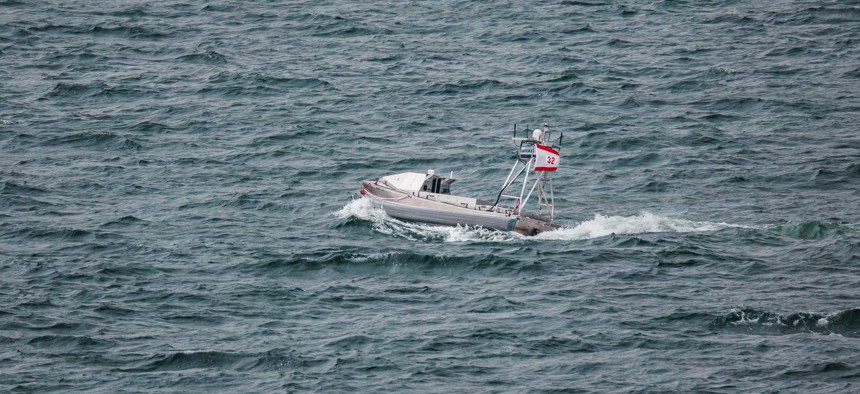
A global autonomous reconnaissance craft operating in a swarm exercise in the Baltic Sea on June 13. Navy photo by Chief Petty Officer Chad Butler / U.S. Naval Forces Europe-Africa / U.S. Sixth Fleet

 By
Ross Wilkers
By
Ross Wilkers
The cash-and-stock agreement expands AEVEX beyond drones into surface and underwater autonomous systems.
AEVEX Corp. is only four months into its journey as a publicly traded defense technology company and is already moving on a big-ticket acquisition that takes it into the maritime domain.
In conjunction with its second quarter financial report, AEVEX said Wednesday that it has agreed to acquire autonomous and unmanned vessel maker BlackSea Technologies for $600 million in cash and stock.
BlackSea develops its vehicles to operate at the surface of and under the seas for operators in the Navy, Special Operations Command, and other defense and intelligence organizations. Surveillance and congested logistics are among the primary mission sets BlackSea designs the vessels for.
All parties involved expect to close the transaction in September, pending the antitrust regulatory process and other conditions.
During AEVEX’s second quarter earnings call with investors Wednesday, chief executive Roger Wells characterized the transaction as one that also involves increased production capacity in addition to new market entry. AEVEX already specializes in unmanned aerial vehicles, including loitering munitions.
Now with BlackSea entering the fold, AEVEX is essentially looking to set itself up for the Navy’s envisioned future of having more drone boats in the field and the funding to support that path.
Wells cited the conflicts in Ukraine and Middle East, including Iran, as examples of where unmanned vehicles are becoming a larger part of force structures. BlackSea’s vessels have logged nearly 500 hours in support of U.S. operations in Iran since that war started on Feb. 28.
“We believe that structurally, over the long term, it's going to be a well-funded supported priority as part of the budgets moving forward,” Wells told analysts. “We absolutely see the opportunity to cross sell unmanned air, unmanned surface and subsurface as multi-mission, multi-domain capabilities are going to continue to be needed across multiple different operational scenarios.”
BlackSea produces 40 small unmanned surface vessels per month and has delivered 350 of them since its 2022 inception, Wells said. BlackSea does this through a research, development, test and evaluation facility covering 57,000 square feet and a separate production facility spanning 47,000 square feet.
In addition to that physical footprint, BlackSea is also bringing 275 employees to the combined company and an expected revenue contribution of $150 million for this year. BlackSea also is touting a $110 million funded backlog tied to programs associated with its flagship Global Autonomous Reconnaissance Craft vessel.
GARC is built to operate in the field for up to 10 days at a time and has been used to support the Navy’s Fifth Fleet operations in Bahrain, Wells said.
“BlackSea is solving three core problems for the customer: rapid force projection through immediate large-scale unmanned surface vessel deployment, operational risk mitigation by using unmanned combat support to reduce risk to human life, and capability versatility across a diverse set of mission needs, including mine clearing from a single adaptable platform,” Wells added.
Hardware is one part of the technology equation that AEVEX is looking to create by purchasing BlackSea.
AEVEX also designs its CompassX core autonomy software stack as an open architecture that connects different crewed and uncrewed systems in the field.
CompassX’s core functions include precision targeting and situational awareness, as well as what the company calls A2PNT -- assured positioning, navigation and timing.
Wells said BlackSea also builds its systems on a modular open systems architecture, a setup that is intended to allow operators to replace and upgrade components on an as-needed basis.
“This architecture creates the opportunity for us to leverage our CompassX technology stack to enable autonomy and multi-domain interoperability across all of our combined platforms,” Wells said. “As the (Defense) Department shifts towards contractor-owned, contractor-operated or COCO structures and larger USV and UUV programs, having an extensible architecture becomes a durable competitive moat.
AEVEX completed its $320 million initial public offering in April as part of an ongoing run of defense and space tech companies also listing their stock on the markets.
The $600 million purchase price for BlackSea breaks out to $250 million in cash and $350 million in shares of AEVEX stock, or $27.50 per share. The agreement also includes a potential $50 million earnout if the business hits certain performance milestones.
BlackSea’s pending sale is also an exit for Razor’s Edge Ventures, a venture investment firm that founded the company in 2022 through a series of transactions involving Maritime Applied Physics Corp. and three other businesses.
AEVEX’s advisers on the transaction are Jefferies, Kirkland & Ellis LLP and Crowell & Moring LLP. BlackSea’s advisers are Raymond James and Cooley LLP.