
How Rocketdyne is re-entering the space sector as a standalone entity
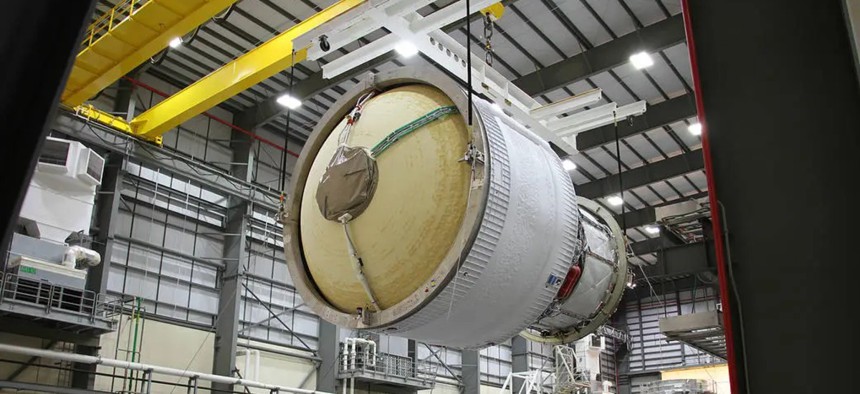
The Interim Cryogenic Propulsion Stage for the second flight of NASA’s Space Launch System in July 2021, inclusive of a single RL-10 engine. NASA photo.

 By
Ross Wilkers
By
Ross Wilkers
The six-decade-old space propulsion systems maker brought its old name back and is ramping up to fulfill demand for its products, as a partner for Rocketdyne's majority owner tells us.
From early negotiations and onward, little doubt existed at AE Industrial Partners that the name “Rocketdyne” would come back after acquiring controlling ownership of the business from L3Harris Technologies.
In fact, AE Industrial’s agreement to acquire its 60% stake in the space propulsion and power business dictated that the now-standalone company would revive the name.
Rocketdyne was officially relaunched on Aug. 4 following the closure of the transaction, under which L3Harris keeps the other 40% and stays involved as a key strategic partner.
“We have some employees in the company today that have been with Rocketdyne for 45-plus years, and the last thing we wanted to do was pay a marketing company for some new name and try to go out to the market as a new space company when we have six decades of heritage,” Jon Luszakoski, a partner at AE Industrial, told Washington Technology.
This new iteration of Rocketdyne does look slightly different from the Aerojet Rocketdyne that L3Harris acquired in 2023.
Rocketdyne’s focus areas under AE Industrial’s ownership cover launch vehicle engines like the RL-10, in-space propulsion thrusters, space electronics, and systems for nuclear power and energy.
L3Harris kept the solid rocket motor and other missile-focused portfolios, which are part of the Missile Solutions business now scheduled to go public in 2027. The RS-25 engine used to power NASA’s Space Launch System is also staying with L3Harris.
For Rocketdyne and its 1,300 employees, the focus on propulsion means the company is positioned as a key supplier of thrusters and other similar systems to larger defense hardware companies.
Many of those larger companies then incorporate Rocketdyne’s products into full satellites for delivery to U.S. government agencies like Space Force, Luszakosk said.
Rocketdyne’s revival in the market also comes amid Space Force’s overall effort to be more mobile in space, which will involve satellites and other systems having greater maneuverability.
“We’re probably going to see a 2-to-3 times increase in the number of thrusters we’re producing over the next three years, all fulfilling demand that we’re getting directly from our customers,” Luszakoski said. “It’s going to require some investment to meet that demand.”
Luszakoski said those investments will include Rocketdyne’s manufacturing capabilities to increase production, along with acquisitions around other types of propulsion technology to expand the company’s product offerings.
Rocketdyne will also look to explore greater use of modern manufacturing techniques like automation tools to aid workers and three-dimensional printing, the latter of which is a path the company already has traveled down.
The new version of the RL-10 has a handful of 3D-printed parts and that has brought down the total part count down by 90% for some of the engine’s subsystems, Luszakoski said. Rocketdyne has also looked at 3D printing for other end-space propulsion systems.
“As we sell more of the same thruster, we’ll be able to make investments in the manufacturing and particularly around automation that will be a better return to the company,” Luszakoski said. “For a lot of the demand that we’re seeing, we’re trying to focus on a couple of different propulsion systems to get build times down, lead times down and use automation to help with that.”