Argonne National Laboratory seeks help, resources for AI supercomputing center
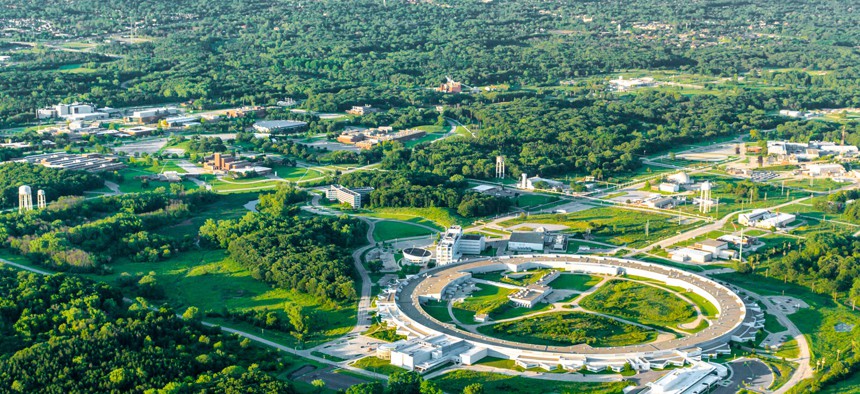
Aerial image of Argonne National Laboratory. Argonne National Laboratory / Flickr

 By
Ross Wilkers
By
Ross Wilkers
The lab is casting its net far and wide for ideas on how to build, operate and finance the future National Genesis Mission Supercomputing Center of Innovation.
Argonne National Laboratory has embarked on market research efforts to ask industry, academia and other private sector entities for ideas on how to build a large-scale supercomputing center with artificial intelligence at the core.
In late May, Argonne unveiled a new platform for giving researchers access to various AI models in support of the Energy Department’s Genesis mission for spurring advanced innovation in this tech field. Genesis heavily relies on federal datasets and resources to inspire research and innovation efforts in AI.
A sources sought notice posted Tuesday describes Argonne’s vision for the future National Genesis Mission Supercomputing Center of Innovation that would be located on the lab’s property in Lemont, Illinois.
Argonne is a federally-funded research-and-development center that works on problems related to energy, physics, chemistry, materials science, environmental sustainability, supercomputing and national security.
The lab is asking respondents to offer approaches for implementing AI infrastructure that can support research, development, demonstration and mission-focused applications.
Officials at Argonne are particularly interested in hearing from organizations that could provide infrastructure, equipment, software, integration services, operational capabilities, or other technical contributions for the center.
Argonne also is seeking feedback from organizations that could use, co-fund, sponsor or reserve AI computing capacity at the center through various types of partnership arrangements in future years.
One key aspect of such partnerships involves the funding model. Argonne wants to largely avoid the use of taxpayer funds and instead lean on substantial private sector investment to finance much of the center’s infrastructure.
In the request for information, Argonne estimates that it will need at least $6 billion in private investment during the first 18 months of construction and deployment of the center’s initial phase.
The RFI also asks for input on the non-tech resources needed for the center including future governance, user access, allocation models, co-funding approaches, consortium structures and workforce development frameworks.
Organizations that are not in position to provide large-scale capital investments can also get involved by proposing equipment, software, services, pilot projects, test beds, operations support, training, and other complementary capabilities.
Responses to the RFI are due by 4 p.m. Eastern time on Aug. 21.