
How Leidos looks at the military's electronic health record plan
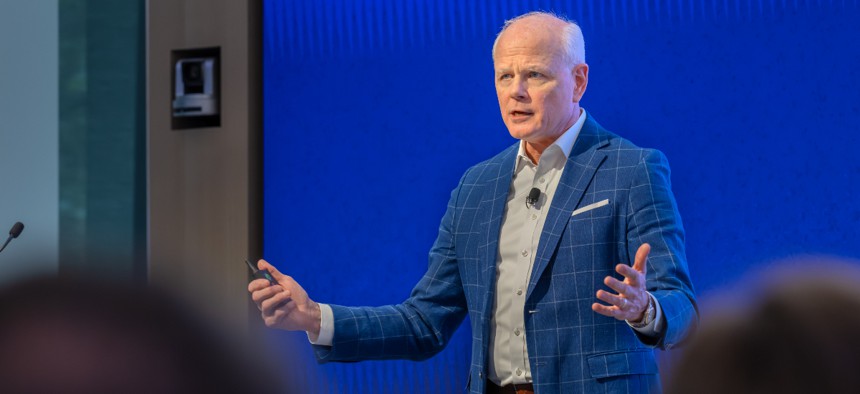
Leidos chief executive Tom Bell speaking to the company's CEO Town Hall event in May at its Reston, Virginia corporate headquarters. Leidos photo.

 By
Ross Wilkers
By
Ross Wilkers
In talking with Wall Street, Leidos CEO Tom Bell goes over the Defense Health Agency's push to take on more integration responsibilities and where he sees the company fitting into that.
Leidos is viewing the Defense Health Agency’s plan for the next iteration of the military’s electronic health record system as a sign of the government’s elevated interest in taking on more tech integration responsibilities.
In June, DHA laid out a blueprint for transitioning away from the current lead systems integrator model for the MHS Genesis system toward a setup of direct contracts with the providers of the underlying technologies.
DHA is planning to continue working with Leidos, the lead Genesis integrator, under a series of bridge contracts to help facilitate that shift. The agency is eyeing the summer of 2027 for completion of the tech providers’ transitions away from the current managed model.
During Leidos’ second quarter earnings call with investors Tuesday, chief executive Tom Bell indicated the Genesis program is not the only example of where the government wants to take on more.
“What they're interested in (regarding) in-sourcing is the systems integration, but also the acquisition of commercial technology, per the aspirations of this administration,” Bell said. “We see that trend continuing across many agencies.”
On a government-wide basis, the Trump administration has sought to recast the roles and responsibilities of integrators like Leidos in order to have more direct relationships with commercial tech companies. This push includes still-in-the-works changes to acquisition regulations and efforts to track how agencies conduct commercial acquisitions.
For Genesis specifically, Oracle Cerner is the provider of the baseline electronic health record that feeds into the overall systems of systems. Philips North America, American Well Corp., Henry Schein and Solventum Health Information Systems are also part of the Genesis ecosystem.
Bell touted Leidos’ work on the prime contract since 2015 as helping get DHA to a place where “they can now commercially acquire the software themselves and perhaps do some of the systems integration themselves.”
At the same time, Bell sees a place for Leidos in the future of Genesis.
“There's still a need for us to maintain the system, enhance the system and partner with them in terms of making the system match fit for the future,” Bell said. “While we see a lot of conversations around in-sourcing and it's understandable why our customer would want to make sure that they have organic capability, It's difficult to see that they can in-source it all and have the manpower necessary to do the whole work.”
DHA on July 31 selected a dozen companies for a potential five-year, $300 million professional services contract focused on product deployment efforts across the agency’s health IT environment that includes Genesis.
Leidos was one of those chosen for the contract, indicating the company is indeed maintaining a connection with Genesis in some respects.
Second quarter revenue of $4.5 billion was 7% higher than the prior year period and 4% up on an organic basis, while profit of $631 million showed a 2% year-over-year decrease in adjusted EBITDA (earnings before interest, taxes, depreciation and amortization.
Leidos lifted the low end of its full-year revenue guidance to $18.2 billion from $18 billion, with the high end unchanged at $18.4 billion. The company is also holding to its adjusted EBITDA margin outlook of mid-13%.