
Leidos hones cyber product bet on the 'whole AI-powered patching process'
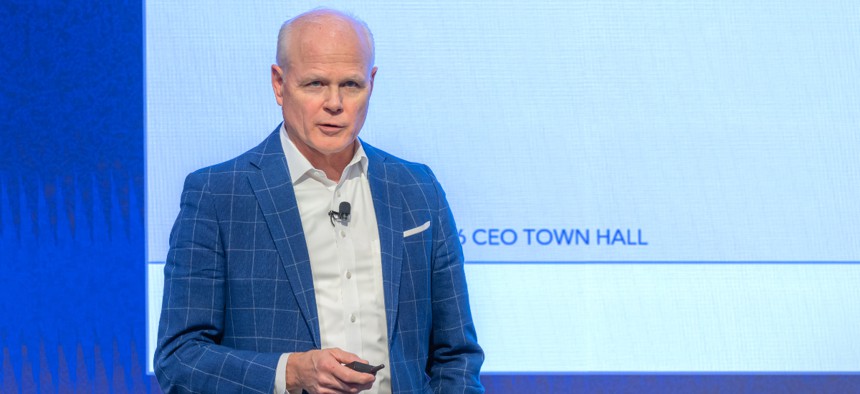
Leidos chief executive Tom Bell speaking to the company's CEO Town Hall event in May at its Reston, Virginia corporate headquarters. Leidos photo.

 By
Ross Wilkers
In talking with Wall Street, chief executive Tom Bell sheds some light on Leidos' new Parcata offering that relies on large language models to find security problems with software.
Leidos is in the early phases of helping its intelligence agency customers use a new automated cybersecurity platform for finding software vulnerabilities across enterprise networks and fixing them without manual intervention.
If those efforts go well, Leidos believes it will have found a boon for its commercial cyber and AI product portfolio in an age where conversations about automation and security are one-and-the-same.
During Leidos’ third quarter earnings call with investors Tuesday, chief executive Tom Bell described the Parcata product as designed to complete “the whole AI-powered patching process in minutes, far faster than existing options.”
Parcata works off of multiple large language models to look at vulnerabilities in first- and third-party software, while also patching zero-day vulnerabilities in real time. Leidos hopes to make Parcata more widely and commercially-available later this year, Bell told analysts.
Parcata was developed by Kudu Dynamics, the cyber specialist Leidos acquired back in the spring for $300 million. Kudu first started working on Parcata as part of the Defense Advanced Research Projects Agency’s AI Cyber Challenge that tasked participants to build autonomous cyber reasoning systems.
Launched in 2023, the AI Cyber Challenge focused on using AI and LLMs more specifically to automatically discover and patch software vulnerabilities in open-source critical infrastructure.
Anthropic’s Mythos model is the most widely-known example of these LLMs that analyze large amounts of software and system data, then bring up weaknesses and potential attack paths to defensive cyber operators. These types of models can also be used for offensive operations.
“AI-powered vulnerability detection is a big problem for every company and everybody who has a computer system right now, and Parcata is the automated way to do that without human interface,” Bell said. “It is a real-time, very effective patch that makes the speed of detecting, patching and deploying in minutes, and obviously, that's something that the world needs more of.”
Given this was said to a group of Wall Street analysts, they sought to better understand the market opportunity for Leidos.
Bell acknowledged some inherent difficulties in providing great detail on that front, given how the tech landscape functions and especially in the age of AI.
“At this point, given the speed with which this whole market is moving, we can't exactly bound what that means for us,” Bell said.
A second item of interest for analysts involved Leidos’ maritime portfolio, which the company has identified as one of five priority areas that will shape the business through 2030.
In September, the Navy awarded contracts to three companies for the production of 30 medium-sized unmanned surface vessels at about $40 million in work for each. Galliano Marine Services, HII and Saronic are tasked to build 10 vessels each with the first expected to be delivered in the fourth quarter of 2027.
Leidos recorded successful trials of its vessels, but was not chosen for a production contract in this round. The company will be eligible for future contracts as part of the second phase and remains in the MUSV program’s marketplace.
“We were disappointed. We would have loved to have booked an order for 10 of those vessels,” Bell said. “That didn't come our way. But we're in the marketplace, and we certainly don't see it as a dead end, so our maritime ambitions remain robust.”
The MUSV program is not the only place where Leidos is looking for maritime market share. Bell said Leidos is “actively working several very intense customer engagements,” both within the Navy and elsewhere across the Defense Department, to deliver the products it is offering for the MUSV competition.
Third quarter revenue of $4.6 billion was up 4% over the prior year period, while profit of $664 million showed a 5% year-over-year increase in adjusted EBITDA (earnings before interest, taxes, depreciation and amortization).
Leidos lowered its full-year revenue guidance to between $18 billion and $18.2 billion, down from the prior range of $18.2 billion-to-$18.4 billion, with the adjusted EBITDA margin outlook left at mid-13%.
Leidos said the revised guidance partially accounts for the transaction involving its now-former security screening technology business, which merged with Analogic in early October to form a joint venture that Leidos is the minority owner of.