
TOP 100: DLT's new leader bets on distributors as 'orchestrators,' not middlemen
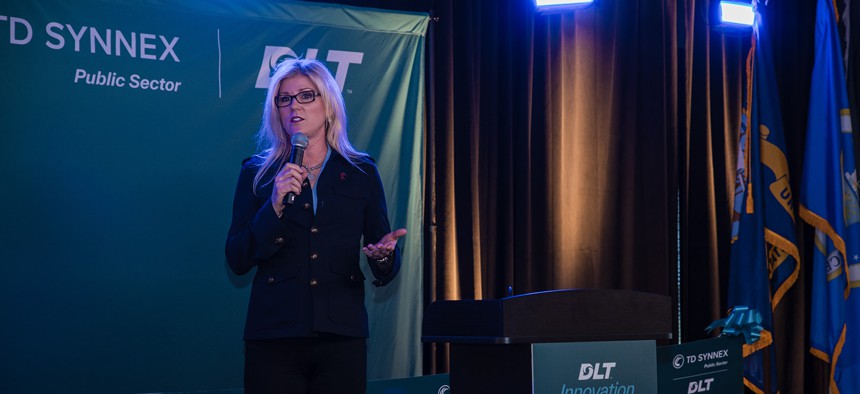
Wendy Welch speaking at the recent opening of the DLT Innovation Center in Herndon, Virginia. DLT/TD Synnex

 By
Nick Wakeman
By
Nick Wakeman
Wendy Welch tells us that pricing volatility, artificial intelligence and the OneGov initiative's push toward more direct agreements with tech names make resellers like Company No. 87 more essential — not less.
Wendy Welch did not join TDSynnex's public sector arm to keep the DLT Solutions business running the way it always has.
Three months into the job, she is betting that distribution is about to become more important to the federal IT supply chain — a far cry from being squeezed out by the General Services Administration’s OneGov push toward more direct relationships with original equipment manufacturers.
The success of value-added distributors such as DLT — No. 87 on the 2026 Washington Technology Top 100 — will rely on leaning in on their role as “orchestrators,” said Welch.
“Our leadership is pushing us on innovation, making sure that we stay not just at the center of the ecosystem, but continue to evolve our solutions approach to make sure we’re orchestrating and complementing the complex solutions that are needed in the market,” added Welch, senior vice president of public sector sales at TD Synnex.
Distributors can be disruptors in the market and play an even more important role because of the complexity of the solutions government customers need, she said.
Pricing volatility ties into part of that complexity, Welch said.
“Some of our vendors can only hold prices for seven days, so we’ve seen scenarios where thousands of quotes have to be repriced every seven days or 14 days across multiple partners,” she said.
When Welch talks about vendors, she is referring to original equipment manufacturers. Partners are the resellers that sell OEM products to government customers.
Increased pricing volatility has driven DLT and TDSynnex to adopt more artificial intelligence tools and automation.
“The investments have been a differentiator for us and how we serve our partners,” Welch said.
Sales of certain commodity products, such as peripherals and monitors, are more transactional and can be automated to large degree.
“It frees up our team to work on the more complex or higher touch engagements,” she said.
DLT thinks of itself as customer zero when leveraging AI solutions.
“It is hard to promote a solution that you’re not using yourself,” she said. “It’s really important to us to bring those experiences and build the skills of our co-workers.”
The goal is to build what she called “AI fluency” across the workforce.
A second key investment area for the company is a cyber range in Herndon, Virginia. This is second such facility the company has built after establishing one in Gilbert, Arizona.
DLT wants to bring vendors and partners together with customers to work through challenges, undergo training and run live-attack simulations to demonstrate different solutions.
A second driving force in the market is GSA’s OneGov initiative, where the agency is signing more agreements with OEMs to bring together more of the government’s buying tnstead of agency-to-agency.
For Welch, OneGov is an example of the constant change that churns the market. Companies need to put a premium on agility and flexibility.
“If we think everything is going to stay the same, then we’re kidding ourselves,” she said. "We look at the outcomes that our customers need to implement.”
By keeping the customer at the center and then tracking back through the supply chain and the technology ecosystem, Welch believes DLT "will continue to find routes to the market and customers that benefit from our services.”