
SAIC's challenges are hardly unique, but still put pressure on its outlook
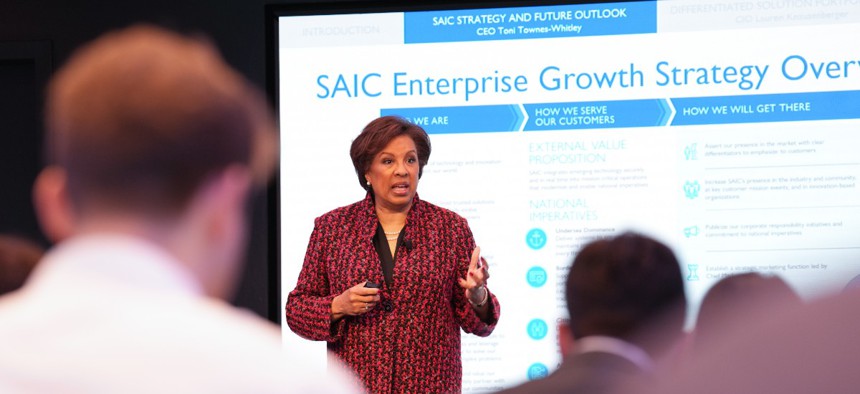
SAIC CEO Toni Townes-Whitley briefs 2024 Investor Day attendees on the company's strategy. SAIC photo.

 By
Ross Wilkers
By
Ross Wilkers
In talking with Wall Street, CEO Toni Townes-Whitley gets candid about the market's volatility and how the company has pulled back some of its expectations.
Science Applications International Corp. has been transparent about its ongoing strategic pivots and efforts to reinvigorate organic growth, but the company is also finding today’s environment more challenging to navigate than it previously thought.
Agencies were slower to obligate funds against active contracts and ramp up new programs, while award delays also remained a fact of life during SAIC’s fiscal second quarter. The continued scrutiny on government spending and federal workforce numbers also are overhangs on the industry.
Against that backdrop, SAIC lowered its fiscal year 2026 revenue guidance to $7.25 billion-to-$7.325 billion from the prior $7.6 billion-to-$7.75 billion range. That signals expectations of a 2%-to-3% organic decline.
The company also cut its fiscal 2027 sales goal to $7.30 billion-to-$7.50 billion from the previous $7.95 billion-to-$8.1 billion range.
During SAIC’s second quarter earnings call with investors Thursday, chief executive Toni Townes-Whitley said the company expects to see a more settled landscape in its 2027 fiscal year that starts on Feb. 1.
But choppy waters seem to remain the norm in the meantime, as SAIC is seeking to tell everyone in its new top-line guidance ranges. Fiscal 2026 revenue expectations are 5% lower than previously anticipated with the fiscal 2027 goal now down 7.5%.
“We have all acknowledged the volatility in the market over the last few quarters with changes of fundamental reduction in the government personnel, and I would say a disproportionate impact on government acquisition personnel, which is the channel to the private sector,” Townes-Whitley told analysts.
“We are all are trying to react to this new environment, and delay does not mean that we don't expect things to normalize over time,” she added.
It is worth pointing out that SAIC unveiled its current blueprint for growth in April 2024, about eight months before the Trump administration began. The blueprint’s emphasis on integrating more commercial technology into federal environments also is a theme that industry and government customers have talked about over multiple years.
SAIC and other GovCon companies have had to accelerate some elements of their strategies here in the first eight months of the Trump administration, which has highlighted speed and efficiency of government as major initiatives.
Within SAIC’s context specifically, Townes-Whitley talked about the company's venture capital arm for investing in startups and partnerships with other companies not traditionally thought of as defense contractors as two examples of acceleration.
Reston, Virginia-headquartered SAIC has also pushed toward more of an enterprise operating model since Townes-Whitley joined as CEO in the fall of 2023.
A former Microsoft executive, Townes-Whitley brought over a former colleague of hers in Tim Turitto to lead the work on that front as executive vice president of enterprise operations.
SAIC announced Monday its promotion of 20-year company veteran Bob Ritchie to chief growth officer, a role that reports to Turitto and seeks to unite business development functions with the company’s technology office he previously led.
As SAIC’s chief technology officer since 2022, Ritchie oversaw collaborations with the business groups and innovation office. Ritchie will now oversee efforts to ramp up how SAIC’s various teams in innovation, tech and business development work together in his expanded duties.
For the ecosystem at-large, Townes-Whitley views efforts to reform government acquisition and rewrite the rules for it as “positive for many parts of our market as well.”
She is alluding to the Federal Acquisition Regulation overhaul effort called FAR 2.0, which will be another sign of the market settling after the new rules for doing business with the government are finalized.
But for now, bridging the current environment and keeping its eye on the ball seems to be SAIC’s approach for operating in the short-term and in setting other targets for its future.
“I would argue that as we move into the second horizon of this strategy, we actually will be lined up with where supply and demand should hopefully intersect in what we built and what the government is asking for,” Townes-Whitley said.
Fiscal second quarter revenue of $1.8 billion was approximately 3% lower than the prior year period, while profit of $185 million showed a 9% increase in adjusted EBITDA (earnings before interest, taxes, appreciation and amortization).
SAIC also adjusted its bottom-line outlooks for this current fiscal year and the next one, like it did with the revenue guidance revisions.
For this current fiscal year, SAIC now sees a range of $680 million-to-$690 million in adjusted EBITDA versus the prior range of $715 million-to-$735 million. That indicates a margin of 9.3%-to-9.5% versus the prior 9.4%-to-9.6% outlook.
The company's fiscal 2027 profit outlook now is in the range of $705 million-to-$715 million, representing a margin of 9.5%-to-9.7%.
NEXT STORY: Microsoft hires SAP vet as corporate federal VP