
Booz Allen commits $400M to Andreessen Horowitz's late-stage fund
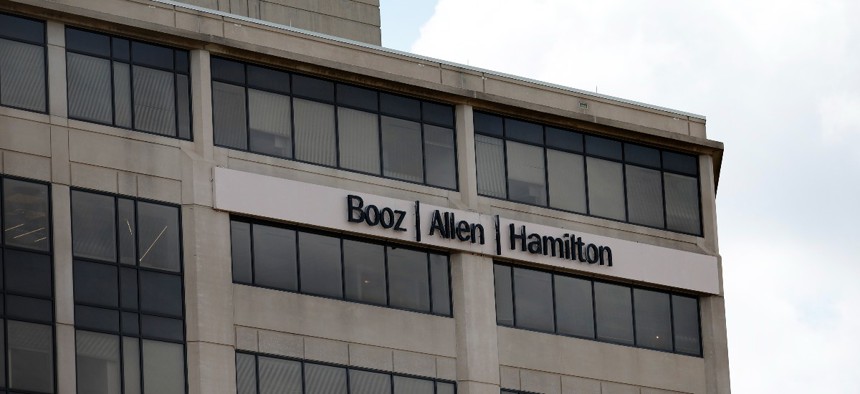
Booz Allen Hamilton's corporate headquarters in Mclean, Virginia. Photo by Kevin Dietsch / Getty Images

 By
Ross Wilkers
By
Ross Wilkers
The government contractor and venture capital firm alike are looking to expand their networks through this capital infusion as well as a related tech partnership pact.
Booz Allen Hamilton’s partnership with Andreesen Horowitz, one of the venture capital landscape’s highest-profile firms, will go beyond just helping startups land government contracts and developing new technologies.
Only days ago, Booz Allen announced it would connect 16z portfolio companies into the government contractor’s network with an eye toward helping these firms navigate the federal landscape.
In conjunction with that, a16z said it fetched $15 billion in capital across five separate funds including “American Dynamism.” That $1.18 billion vehicle focuses on defense and other industries where the U.S. government is either a customer or key stakeholder.
During Booz Allen’s fiscal third quarter earnings call with investors Friday, chief executive Horacio Rozanski said the contractor has committed to deploy $400 million into a16z’s late-stage venture fund.
That figure exceeds the size of Booz Allen’s own venture investment fund, which tripled to $300 million during the summer and launched in 2022 at $100 million. Booz Allen also added reindustrialization as a new focus area alongside the contractor’s long-standing interests in artificial intelligence, cybersecurity, defense, and deep tech.
But in working with a16z, Booz Allen also is expanding its own network of relationships into the ecosystem of startups and other young companies looking to establish footprints in the federal market.
“Together, we will co-create unique commercial tech for national security, public safety, healthcare and other government missions,” Rozanski told analysts.
Under President Trump, the Defense Department and other federal agencies have made it no secret that they want to expand the industrial base to include more emerging companies like those backed by a16z.
Friday's call took place three days prior to the Treasury Department's Monday announcement that it is cancelling all 31 of its contracts with Booz Allen. Our story on that development can be read here.
Also on the call, Booz Allen executives provided an update on the civilian business that has borne the brunt of cost-cutting efforts at the company amid slowdowns in procurement activity among those agencies.
Booz Allen’s headcount fell 12% from the prior year period to 31,600 as of Dec. 31, owing to several rounds of layoffs including an initial 7% workforce cut.
Kristine Martin Anderson, Booz Allen’s chief operating officer and its former civil business president, said “what changes is the approach” with respect to the missions contractors support at civilian agencies.
The current trend with these agencies is “funding smaller amounts more frequently,” Anderson said, but often at places where the workforce has also shrunk.
In other words, Booz Allen is seeing on-contract growth start to pick up again in its civilian portfolio and new awards slowly being unlocked again.
“You still need a strong (Federal Aviation Administration) and aviation safety, you still need to deliver health care, you still need secure borders, you still need to have the right infrastructure to drive the nation,” Anderson said. “We’re seeing exactly that, the missions are enduring, the same ones that we have invested in for years, but the focus area has changed and now they're really ready to move forward to impact.”
Fiscal third quarter revenue of $2.6 billion was 10% lower than the prior year period, while profit of $285 million showed a 14% year-over-year decrease in adjusted EBITDA (earnings before interest, taxes, depreciation and amortization.
Booz Allen now projects a fiscal year sales decline of 5%-to-6%, compared to the prior outlook of 4%-to-5%.
The contractor did nudge up its adjusted EBITDA guidance range to $1.195 billion-to-$1.215 billion, compared to the prior $1.19 billion-to-$1.22 billion outlook. That new profit guidance keeps the adjusted EBITDA margin expectation at mid-10%.
NEXT STORY: Treasury cancels all Booz Allen contracts