
Public offerings put GovCon in a new spotlight as SpaceX's listing looms
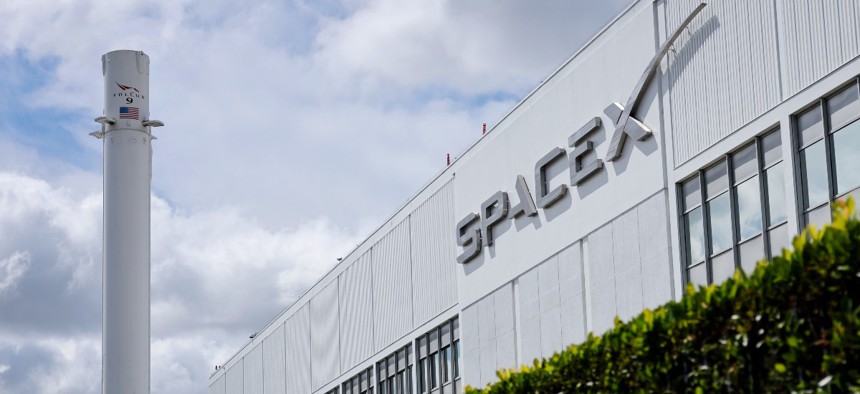
A SpaceX Falcon 9 rocket is displayed at a SpaceX facility on April 2 in Hawthorne, California. Photo by Mario Tama / Getty Images

 By
Ross Wilkers
By
Ross Wilkers
Think the recent run of initial public offerings over the past 16 months were big? Get ready for SpaceX to break all-time records, and its IPO is one all of GovCon should care about, even if your company does not launch anything at all.
Initial public offerings that take the traditional path from the registration document filing to the commencement of trading are so rare in the government market that we should take a roll call of recent IPOs.
After all, IPOs bring more attention to a company and the market it participates in than most other business decisions it will make absent a transformative acquisition or sale to another buyer.
The past 16 months especially have given us a run of space-focused IPOs from Voyager Technologies, Firefly Aerospace and York Space Systems that shed light on an industry re-entering the mainstream conversation.
Merlin Labs closed its IPO in March, while the L3Harris Technologies rocket motor business and AEVEX Corp. are moving toward their public listings as we speak. HawkEye 360 has only just started on a journey that will put the satellite operator into a kind of spotlight that only an IPO can provide.
Prior to this run of IPOs, one must harken back to Parsons Corp. in 2019 and Telos Corp. in 2020 as the most recent examples of GovCon companies that took the traditional IPO pathway.
Step one of the traditional pathway is filing the S-1 registration statement for all to see, then comes the roadshow to tell the company’s story and get literal buy-in from investors, followed by the pricing of the shares, and then the start of trading on either the New York Stock Exchange or NASDAQ market.
Most of the GovCon public listings we cover happen via complex spin-merge transactions such as those that involved Amentum and Leonardo DRS during the past four years. The formations of what was CSRA and Perspecta also fit into that category.
How one labels these decisions to enter the public company universe is not the point. The fact that companies decide to share all of their business with the public is the point as they have to make sure their narrative is in alignment with the numbers.
Which brings us to SpaceX, the launch company Elon Musk started in 2002 that has rewritten the rules of the road for space ever since.
Think all of the aforementioned GovCon IPOs and other public listings were big? Just wait until SpaceX undertakes its public offering in search of $75 billion in proceeds and a valuation of $1.75 trillion, figures that will set all-time IPO records and do not seem real to write for Washington Technology.
May is when SpaceX is reportedly planning to release its much-anticipated S-1, which finally will lift curtains on its financial profile and ambitions.
June is for the roadshow that will see Musk and other SpaceX leaders share the narrative to go with the numbers in the S-1. Then the shares will be priced, after which the IPO will be go for launch.
GovCon absolutely should care about SpaceX becoming a publicly-traded company.
The entire ecosystem *has* to care about it, even if the IPO numbers sound fictional (they are real) and your company does not launch anything at all.
SpaceX is certainly a prime government contractor, but it is also a customer that many federal technology integrators and other GovCon firms provide services to in support of launches.
NASA said roughly 2,700 companies were involved in the Artemis II mission and many touted their roles in LinkedIn posts with the #Artemis hashtag. Consider too that just about every contractor is touting space as a core focus area for their business and the majority of them do not make or launch anything at all.
While SpaceX will certainly take up a lot of oxygen in the leadup to its IPO, the web of connections all across the GovCon ecosystem is seemingly endless.
A publicly-traded SpaceX really can be for everyone because it is a lens though which we can learn more about how the industry works, not just gauge its health and wealth.
Of course, we are very curious about SpaceX’s financial profile too and the nature of its government work. We will have some reading to do for sure and plan to take you readers along for the ride, as we do for all IPOs.
A last word on the GovCon IPO chat goes to Jean Stack of Baird. She told my boss Nick Wakeman in a December 2023 episode of our WT 360 podcast to stay tuned for more public listings of companies in the government market.
Maybe we had to wait another year for the dam(n) wall holding up these IPOs and other listings to break open, but having this sort of run of GovCon public offerings always beats the one-off.
SpaceX of course is the ultimate one-off though. Washington Technology will really get to write about a record-breaking IPO with seemingly unbelievable numbers --. $75 billion in proceeds and a valuation of $1.75 trillion.
Somehow, we will wrap our heads around those figures. And write them.